The rapid pivot to a re mote education format during the 2020 pandemic, necessitated an agile approach to teaching and assessment. With bioscience class sizes ranging from ~25-720 students, ascertaining how well students understood taught concepts, was an essential yet challenging task. Despite the diversity of class sizes and subject areas, some tried and tested methods were found to be more effective and user friendly, for both our students and staff. Continue reading “Gauging student engagement and understanding remotely – some tried and tested methods”

Part 2: Teaching in the HyFlex Classroom: Benefits and Challenges
This article has been divided in two parts. Part 1 explains what HyFlex is and which are the key points to consider before using it. Part 2 presents a wide range of teaching activities that can be used in a HyFlex classroom. Continue reading “Part 2: Teaching in the HyFlex Classroom: Benefits and Challenges”

Part 1: Teaching in the HyFlex Classroom: Benefits and Challenges
This article has been divided in two parts. Part 1 explains what HyFlex is and which are the key points to consider before using it. Part 2 presents a wide range of teaching activities that can be used in a HyFlex classroom.
Continue reading “Part 1: Teaching in the HyFlex Classroom: Benefits and Challenges”
Part 2: Kaltura at the University of Padua
This article has been divided in two parts. Part 1 discusses the background and training required for implementing Kaltura, as well as the reasons and methods for using it. Part 2 discusses the benefits of having a university video platform and strategies for student engagement. Continue reading “Part 2: Kaltura at the University of Padua”
Part 1: Kaltura at the University of Padua
This article has been divided in two parts. Part 1 discusses the background and training required for implementing Kaltura, as well as the reasons and methods for using it. Part 2 discusses the benefits of having a university video platform and strategies for student engagement. Continue reading “Part 1: Kaltura at the University of Padua”
Using Automation to Facilitate Flipped Learning
With the move to fully online teaching, it soon became apparent the most advanced KEATS (Moodle) training session, KEATS 3: Personalising the Learning Experience, was not appropriate for synchronous delivery. The session was re-designed as a completely flipped session, but attendees would often miss the pre-work instructions. The use of Microsoft Power Automate was explored to automate instructional emails, but the uses of the tool were further reaching than initially considered. Continue reading “Using Automation to Facilitate Flipped Learning”
HyFlex physiology practicals during lockdown
The Covid-19 pandemic has highlighted the need for new flexible approaches to teaching and learning to ensure excellent student experience. One aspect of both undergraduate and postgraduate teaching in physiology, that has been most affected, is the delivery of practical classes and skills teaching. This experiential mode of teaching is invaluable in supporting the taught, theoretical component of Bioscience education.
HyFlex teaching environments allow a combination of in-person and remote delivery ensuring no student is disadvantaged in terms of learning experience if they are unable to attend taught classes in person. It also allows such teaching to be recorded for upload and later reviewed by students to support learning. There are limited HyFlex teaching high spaces available across the College which are currently restricted to classroom spaces. We believe that greater availability is required to facilitate practical and laboratory skills training.
Whilst we had already recorded high quality videos of all the practical classes for our MSc course, in preparation of online delivery we were aware that this mode of education works best with supplementing a hands-on experience. Therefore, we sought a way for the students to gain some experience in the essential laboratory skills needed for understanding of the key mechanisms underpinning our teaching as well as providing skills training in techniques they would require in later modules on the MSc and in their research project.
During semester 1 in the current academic year (October 2020), we successfully ran 8 HyFlex teaching sessions in our teaching laboratories in the Centre for Human Applied Physiology (Shepherds House, Guys Campus).
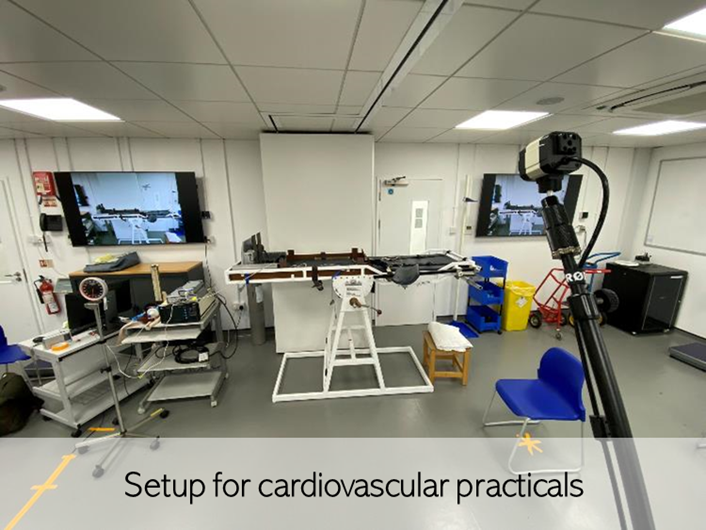
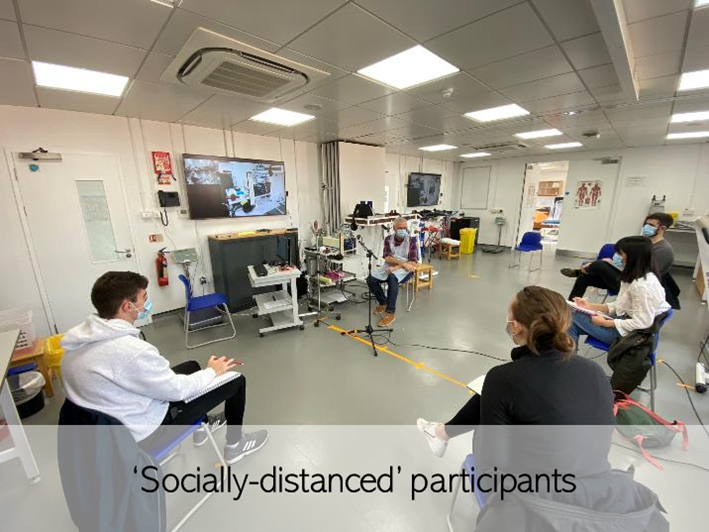
Figure 1 A) The Lab setup for a cardiovascular practical class showing camera, equipment, and screens. B) the class in action with a tutor demonstrating equipment and skills with live feed streaming over Teams.
We used commercially available low-cost portable equipment (owned by the authors) open-source software (Open Broadcast Software, OBS) to create a bespoke HyFlex teaching environment in one of our teaching labs following a full risk assessment.
As shown in Figure 2, i) two webcams (one for a wide-angle camera and one, mobile camera, for images of equipment and participants); ii) a radio microphone to ensure clear audio on both the recording and live stream and, iii) a PC laptop to run the software required for the experiment being undertaken and for video and audio mixing and broadcast were used.
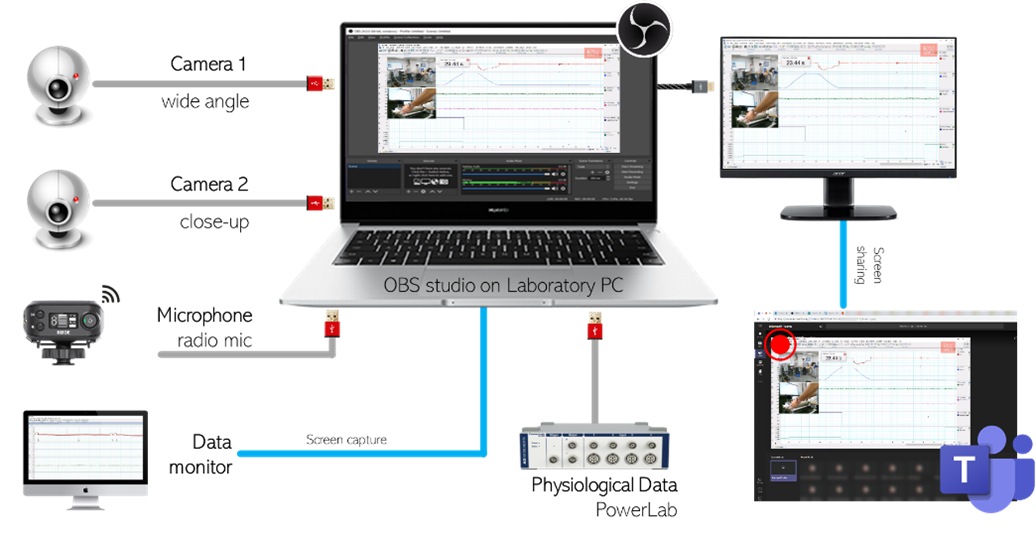
Figure 2: Setup of equipment using standard office supplies, open-source software, and staff-owned equipment.
All the sessions were recorded and uploaded to KEATS for revision purposes.
This approach was used for our module 7BBLM004, Cardiovascular and Respiratory Physiology, which forms a core part of the MSc in Human and Applied Physiology.
Due to social distancing and limits on room capacity we repeated each practical on 4 occasions during each day of teaching, with several students joining for both their in-person session as well as the remote HyFlex session at a different time point in the day.
The students were incredibly supportive and grateful for the opportunity to receive some practical teaching, particularly as some were unable to join the in person practical classes. Feedback from the students confirmed that the classes were beneficial and that the participants felt safe while on campus and in the classes (Figure 3).

Figure 3 – Feedback from students following the HyFlex practical sessions.
We believe this approach offered enhanced participation to on-campus activities by those students who cannot attend in person for courses and modules which have a significant laboratory practical component.
Written by Dr James Clark & Dr Ged Rafferty
 Dr James Clark is a Reader in Human & Applied Physiology and Education Lead for the School of Cardiovascular Medicine andSciences. He currently runs the Human & Applied Physiology MSc. James supports a blended approach to education in HE and has been the recipient of a King’s award for innovative teaching (2017) as well as the Physiological Society Otto Hutter Prize for Excellence in Physiology Education (2019).
 Dr Ged Rafferty is a Reader in Human & Translational Physiology in the Centre for Human and Applied Physiological Sciences He is currently the lead for 7BBLM004 Cardiovascular and Respiratory Physiology and will assume the lead for the MSc in Human & Applied Physiology in 2021-22. Ged is an advocate for experiential learning and the benefits of practical teaching in human physiology.

ReFlexions on HyFlex
In 2020 we used HyFlex technology in our Research Skills in Pharmacology workshops to recreate the interactivity of class discussions. It allowed students in the classroom to interact with students thousands of miles away, but couldn’t fully recapture the dynamics of small group discussions with everyone in the same place. Continue reading “ReFlexions on HyFlex”

Tech Test Thursdays for Digital Capabilities
When the Covid-19 pandemic put us fully online, colleagues in King’s Academy needed to expand our repertoire with a range of evolving technologies. Since we lead educational development programmes and sessions, we strive to demonstrate intrepid, successful designs which make best use of our learning environments. In the foreseeable future those environments would be digital. This post gives a rationale for carving out regular time to test things out together, followed by details about how we set this up to be low-maintenance. Continue reading “Tech Test Thursdays for Digital Capabilities”
Using student media assignments
In her chapter in the recently published book ‘Languages at work, competent multilinguals and the pedagogical challenges of COVID-19’, Cecilia Goria describes the positive response of staff to the enforced move to teaching online due to the pandemic. This phase was described as Emergency Remote Teaching (ERT) – the quick unplanned response to the lockdown. Hodges et al. (2020) describe the speed with which this move to online instruction happened is ‘unprecedented’ and ‘staggering’. Continue reading “Using student media assignments”