Research on the development and treatment of emotional disorders, discused and digested by the EDIT Lab Team and collaborators

Tag: research (Page 1 of 5)

Q is for Qualitative Research

Iona, our newest 1+3 EDIT Lab student discusses what qualitative research is, why we need it and what we can we learn from it.

Iona, 1+3 EDIT Lab Student


What is qualitative research?

In a world increasingly full of statistics, graphs and numbers, qualitative research provides a different way to understand our lives and the world around us. Quantitative research, including most of the research done in the EDIT lab, uses information that has been converted into numbers. This data is then analysed to understand relationships between variables. For example, if we wanted to investigate depression, we might ask participants to rate their symptoms on a scale from 1 to 10.  Qualitative research, on the other hand, uses words, images, behavioural observations, or anything else non-numeric to understand how people experience a phenomenon or make sense of the world. In this case, we might investigate depression by asking participants to describe their experiences or symptoms. 


Qualitative research rejects the idea that there is a single objective reality which contains a single truth, and instead aims to understand the social and psychological world through the individual perspectives of people across different contexts. Open-ended questions are used to collect rich, detailed data which is used to make context-specific interpretations about patterns and differences in people’s experiences. Flexibility is valued so that emerging themes can be explored further, and researcher subjectivity is embraced as a resource for interpretation. 

So, whilst quantitative research can help us understand general patterns, averages and norms across a population, qualitative research can provide insight into what that really means for an individual or group of people in their everyday life. 


Why are qualitative methodologies useful in mental health research?

Mental health problems are an inherently personal and subjective experience. Thoughts and feelings cannot be directly measured by someone else, which means that researchers rely on an individual’s ability to interpret and describe their own internal psychological experiences. Quantitative questionnaires are an excellent way to understand mental health in large samples, particularly when measuring prevalence or severity, but each respondent needs to match up their experiences to those presented to them in a predetermined list. Qualitative methods allow people to express their experiences in their own words, which creates space for different ways of understanding and describing mental health experiences. This could potentially inform future quantitative research which might collect information in using different words or phrases, or changes to the response options to better reflect people’s lived experiences.


Qualitative approaches are also useful for exploratory research. When there is little previous research to build on, understanding the relevant lived experiences of people with mental health problems can be a good starting point. Asking open-ended questions can generate unexpected themes and ideas, which can easily be investigated further due to the built-in flexibility and iteration of qualitative approaches.

Finally, qualitative research is a crucial tool for innovating and improving mental health interventions and services. The latest MRC-NIH guidelines go as far as saying that purely quantitative approaches are rarely adequate. Understanding patients’ perspectives on which aspects of an intervention or service worked (or didn’t work), and why, is incredibly useful. For example, such feedback can help to evaluate whether interventions deliver improvements in mental health in real-life contexts, above and beyond efficacy seen in randomised control trials.

Qualitative research can therefore help us understand what mental health really means to people and can provide insights which can guide future research questions and improvements in interventions or services.


What can quantitative researchers learn from qualitative research? 

Qualitative researchers are encouraged to reflect on how their personal beliefs, experiences and values have influenced their decisions (a process known as reflexivity). In all types of research, our own beliefs can shape which questions we think are important, which groups of people we think should be studied, and the ways we interpret our results. By embracing researcher subjectivity and reflexivity, quantitative researchers can acknowledge and address the impact of their beliefs on their research. This may encourage more transparent and intentional decision-making and reduce researcher bias.

Additionally, quantitative and qualitative methods can be used at the same time in mixed methods designs. Mixed-methods research can benefit from the advantages of both approaches and examine common patterns arising from both qualitative and quantitative investigations. Working in this way also has the added of advantage of enabling researchers to build multidisciplinary skills.

References

Braun, V., & Clarke, V. (2013). Successful qualitative research: A practical guide for beginners. SAGE.

Jamieson, M. K., Govaart, G. H., & Pownall, M. (2022, February 23). Reflexivity in quantitative research: a rationale and beginner’s guide. https://doi.org/10.31234/osf.io/xvrhm

Shorten, A., & Smith, J. (2017). Mixed methods research: Expanding the evidence base. Evidence-Based Nursing, 20(3), 74–75. https://doi.org/10.1136/eb-2017-102699

Skivington, K., Matthews, L., Simpson, S. A., Craig, P., Baird, J., Blazeby, J. M., Boyd, K. A., Craig, N., French, D. P., McIntosh, E., Petticrew, M., Rycroft-Malone, J., White, M., & Moore, L. (2021). A new framework for developing and evaluating complex interventions: Update of Medical Research Council guidance. BMJ, 374, n2061. https://doi.org/10.1136/bmj.n2061


Mental Health Trajectories. What are they? How are they measured? How are they analysed?


Dr Ellen Thompson, Postdoctoral Research Fellow

Alex Kwong, Research Fellow


The rate of children, teenagers and young adults reporting symptoms of anxiety and depression is higher than ever, with 18.0% of children aged 7 to 16 years and 22.0% of young people aged 17 to 24 years meeting the criteria for a probable mental health condition. The standard way to assess such conditions is with total scores on a symptom scale at a single point in time, so those with high scores can be identified and provided with extra support. However, this type of information often doesn’t tell us how symptoms are developing or changing over time. Importantly, it does not offer us the opportunity to target critical periods of mental health development in which we could intervene to stop symptoms increasing, or even better, intervene to make symptoms improve. 

 This intrigue is at the heart of longitudinal research, which aims to explore and analyse change over time within a person or a group of individuals. This data is collected by asking about the same symptoms, often via a questionnaire, within the same individual, over three or more time points. Historically, this type of information has been challenging to collect as it involves following participants up over time and asking them to fill out questionnaires in person or attend assessments. However, with the advent of the internet, and the use of online surveys and mobile apps, longitudinal data is becoming increasingly available to researchers across the globe. This offers immense opportunity to make inroads in mental health research and identify patterns of mental health that could be transformed into therapeutic strategies and interventions.  

 The majority of mental health researchers use longitudinal data to find out whether (and to what extent) the severity of symptoms are changing within an individual or between individuals. For example, researchers might be interesting in whether an individual’s symptoms are fluctuating over a fixed period (within person change), or whether symptoms differ between people, based on certain characteristics such as sex, family mental health history, school inclusiveness and many more.  

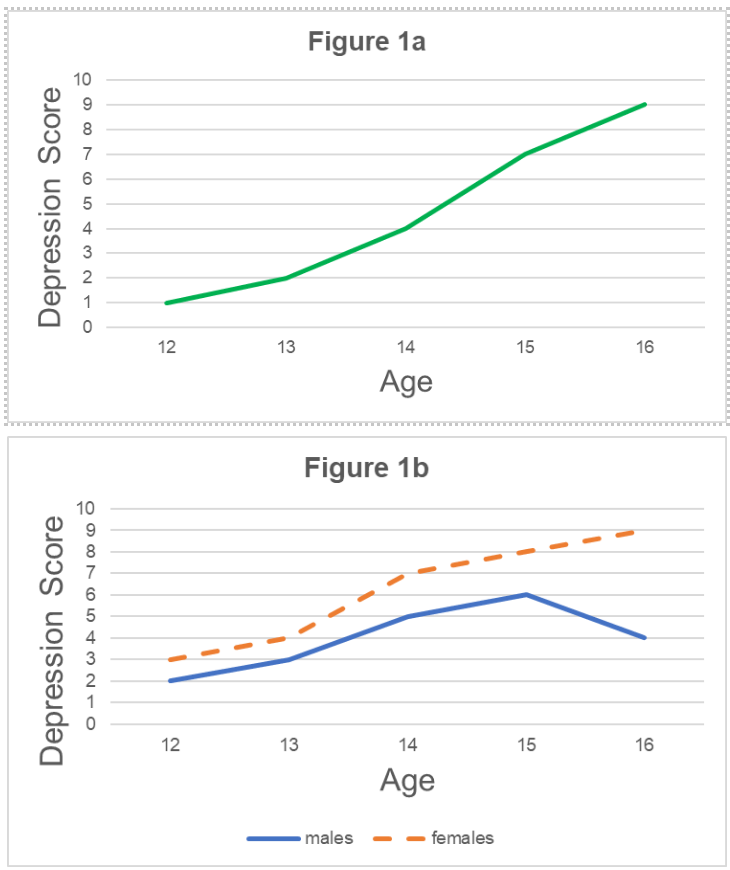
 To visualise this type of change over time, longitudinal researchers tend to model and generate ‘trajectories’ (which represents the course of symptoms over a given period). For example, figure 1a displays an individual’s depression trajectory shifting from low to high over a 5-year period. Figure 1b displays a trajectory for males and females over the same period and shows that females have a much higher trajectory compared to males. These findings are important for developing interventions and support mechanisms for groups that might be at heightened risk of poorer mental health traits.  

Note. These figures were created for example purposes only.

In addition, researchers can also obtain additional information from longitudinal data such as the age and speed at which symptoms are changing over time. This type of information is pertinent as it allows us to pinpoint critical or sensitive periods for when intervention or support might be needed most, and when it might potentially be most effective  

 Mental health researchers have been interested in this type of information for decades, however the tools required to explore or analyse this data can require specialist expertise and software. This can create a barrier for those looking to explore longitudinal data as researchers/or users may not have the time or capacity to learn and implement these skills. To combat this barrier, our team are in the process of creating a data tool (and stepped training component) which readily enables mental health researchers and users with longitudinal data to visualise their data and run models to assess and analyse within and between individual change. Thanks to funding from Wellcome,  we are developing this too to create a starting point for applying longitudinal analytic techniques to repeated measured data and to highlight key periods of development that could be used to provide better support and treatment for at risk individuals. We want to ensure that anyone who has longitudinal data can have the tools to explore and analyse their data.  We see this tool as being useful not only for mental health researchers, but also for any user who has longitudinal data and wants to visualise their data in a speedy and efficient manner. This could be anyone including, but not limited to: teachers, health professionals, clinicians and even charities.  

With the recent availability of large longitudinal datasets with rich, repeated information on youth mental health, now is an important time in which mental health research can really flourish. We hope that this tool plays a part in facilitating future mental health research and look forward to sharing it with you all soon.


Anti Bullying Week 2022

[vc_row type=”in_container” full_screen_row_position=”middle” scene_position=”center” text_color=”dark” text_align=”left” overlay_strength=”0.3″ shape_divider_position=”bottom”][vc_column column_padding=”no-extra-padding” column_padding_position=”all” background_color_opacity=”1″ background_hover_color_opacity=”1″ column_link_target=”_self” column_shadow=”none” column_border_radius=”none” width=”1/1″ tablet_width_inherit=”default” tablet_text_alignment=”default” phone_text_alignment=”default” column_border_width=”none” column_border_style=”solid”][vc_column_text]

Bullying is a major problem in schools across the UK. The purpose of the anti-bullying week, happening from 14th to 18th November 2022, is to bring attention to this issue and discuss the ways by which we raise awareness and help victims of bullying.

Genevieve Morneau-Vaillancourt, Postdoctoral Research Fellow

[/vc_column_text][divider line_type=”Full Width Line” line_thickness=”1″ divider_color=”default”][vc_column_text]

 The Anti-Bullying Alliance, a coalition of various institutions and individuals hosted by the National Children’s Bureau, has organised various events and activities happening this week. These activities focus on initiating meaningful conversations about bullying, finding concrete means to address this issue, and providing useful tools to help support children and adolescents. For example, the Odd Socks day, which is on Monday 14th November 2022, invites everyone to wear odd socks to celebrate the fact that everyone is unique. The hope is that this small gesture brings attention to the importance of inclusion and acceptance of individual differences. 

What is bullying exactly? Many people often confuse bullying with other forms of interpersonal violence, such as victimisation or domestic violence. Therefore, providing a correct definition of bullying is important to identify how and when it happens. Bullying typically occurs between peers (which excludes siblings or romantic relationships). It can happen in person or online (cyberbullying) and can take many forms, including physical, verbal, emotional, or sexual. Bullying is mainly composed of three characteristics (Olweus, 1993). First, it must happen repeatedly over time between the same individuals, meaning that victims of bullying are consistently targeted by the same people (it can be a single individual or a group). Secondly, bullying involves an imbalance of power between bullies and victims. For example, the perpetrators may have a higher social status among their peers or may be physically stronger than their victim. Finally, bullying results from the negative intention to hurt the other person. As a result, victims of bullying often end up feeling down, humiliated, and alone. Whenever violent interactions between children or adolescents meet these three conditions, we can consider that it is bullying.

Why is bullying so concerning? Because research shows that it affects many young individuals and that it can have detrimental consequences on their health. Although prevalence estimates tend to vary across studies, between 10% to 30% of young people may be victims of bullying at school (Chester et al., 2015; Singham et al., 2017; National Center for Education Statistics, 2016). Estimates regarding cyberbullying also tend to fall within this range (Hamm et al., 2015). This means that up to one in three young individuals are affected by some form of bullying, either in person or online. These numbers are especially worrying when considering that bullying is associated with serious mental and physical health problems that often persist over time (Takizawa et al., 2014, 2015). Although this blog focuses to a larger extent on in-person bullying, you can learn more about research on cyberbullying by having a look at this blog in which bullying expert Louise Arseneault shared her thoughts about the subject. You can also check this blog by Alicia Peel about the benefits and drawbacks of online anonymity and its connections with cyberbullying .

Finally, what can we do about it? The good news is that bullying is modifiable so we can put interventions in place to address this problem. Many studies have tested this question empirically. For example, a recent meta-analysis of randomised control trials (which are often considered the gold standard in experimental research) suggests that implementing interventions reduces bullying perpetration and exposure, as well as the negative mental health outcomes often experienced by victims of bullying, like anxiety and depression (Fraguas et al., 2020). This meta-analysis shows that the positive impact of anti-bullying interventions is likely to last over time, with studies showing significant reductions in bullying lasting up to 30 weeks after the intervention ended. Lastly, one interesting finding from this meta-analysis is that anti-bullying interventions involving 140 people have the potential to prevent 1 person from being bullied (if the average rate of bullying is 15%). For cyberbullying interventions this estimate was 167 people. Although these effect sizes may be considered small, they are still encouraging because they mean that universal anti-bullying interventions, offered to entire schools, athletic and cultural groups involving young people have the potential to limit the number of young people exposed to bullying.

This year, the theme for the anti-bullying week is Reach Out. It encourages children, adolescents, parents, friends, teachers, and everyone noticing or experiencing bullying to talk about it with someone they trust. Last year, 80% of primary and secondary schools in England and Wales participated in the anti-bullying week, reaching out to over 7.5 million children and adolescents. Let’s hope that, again, it reaches as many people as possible this year. If you’re interested in learning more about the anti-bullying week and the events taking place this week, you can visit this website.


The EDIT Lab celebrates World Mental Health Day 2022

[vc_row type=”in_container” full_screen_row_position=”middle” scene_position=”center” text_color=”dark” text_align=”left” overlay_strength=”0.3″ shape_divider_position=”bottom”][vc_column column_padding=”no-extra-padding” column_padding_position=”all” background_color_opacity=”1″ background_hover_color_opacity=”1″ column_link_target=”_self” column_shadow=”none” column_border_radius=”none” width=”1/1″ tablet_width_inherit=”default” tablet_text_alignment=”default” phone_text_alignment=”default” column_border_width=”none” column_border_style=”solid”][vc_column_text]

World Mental Health Day, taking place on October 10th, aims to combat stigma and raise awareness for mental health. 


To celebrate, members of the EDIT Lab have reflected on why mental health and well-being should be a global priority and the role of research in meeting this goal.  

Three themes emerged from our reflections:

  • Mental health across development
  • Diversity and mental health 
  • The pervasiveness of mental health & the importance of support

Mental health across development: 

“Mental health problems may begin at a young age, present themselves through various symptoms and persist into adulthood, if left untreated. With our research, we hope to better understand the different patterns of mental health symptomatology and to identify the risk factors associated with poorer outcomes.” ~Elisavet Palaiologou (PhD student)

“When talking about health in general, there are still unfortunately false preconceptions and taboos surrounding mental health problems. My hope is that our research can help understand the vast repercussions that mental health can have and that we can ultimately contribute to the ongoing and growing conversation about the real place that mental care should have in our health care and education systems” ~Dr Genevieve Morneau-Vaillancourt

“Mental health difficulties can affect people of any age and change across a lifetime. Research plays an important role in helping to understand the factors contributing to these changes and how to best support people across development. I hope our research will highlight the need for continued conversations, funding and support of mental health initiatives around the world.” ~Celestine Lockhart (research assistant and PhD student)

“The majority of individuals who experience mental health symptoms in childhood go on to experience symptoms in adulthood. Researching why and when symptoms develop allows us to pinpoint both risk and protective factors as well as target appropriate timings for intervention” ~ Dr Ellen Thompson[/vc_column_text][vc_column_text]

Diversity and mental health: 

“Our research is beginning to understand which individuals are at risk of mental health problems or poor outcomes following treatment. But we need to improve the diversity of our participants so what we find applies to everyone.” ~Prof Thalia Eley

“Almost everyone will know someone who has struggled with mental health difficulties and know how debilitating it can be. This drives many of us to contribute to research that will ultimately help improve prevention and treatment. However, the majority of the global population are underrepresented in genetics research, as studies primarily rely on participants of European ancestry. More work is needed to ensure the experiences of underrepresented groups are included in genetics research so that everyone can benefit from any progress made.” ~Abigail ter Kuile (PhD student)

“Mental health problems can be very disabling and are often associated with many other health-related problems. They tend to worsen the situation and outlook for already vulnerable groups with increased disparities as a result. If we can continue to do research that highlights the full spectrum of human diversity worldwide it will help us understand the equally diverse settings and mechanisms that psychopathology can act through, and ultimately also be of benefit to otherwise disadvantaged groups.” ~Johan Zvrskovec (PhD student)

[/vc_column_text][vc_column_text]

The pervasiveness of mental health & the importance of support

“Everybody has been affected or knows someone who has been affected by poor mental health. By researching the underlying causes of these problems, we hope that new understanding leads to more effective treatments, and reduced stigma, for those who are suffering.” ~Dr Tom McGregor

“The impacts of mental health difficulties are far-reaching especially when they begin in childhood. They can impact multiple aspects of life including emotional development, academic, vocational and occupational attainments, and interpersonal relationships. Where possible, no one should have to endure these alone when support can be provided.” ~Dr Kunle Oginni

“No one is immune from mental health problems, and they can catch up with you when you least expect it. Most people have experienced some form of poor mental health in their lives, and that’s why research such as ours that tries to identify triggers and risk factors for the start of symptoms is so important for both raising awareness, and ensuring that people know how to help themselves, and how to seek external help when in need.” ~ Shannon Bristow (research associate and PhD student)

[/vc_column_text][vc_column_text][/vc_column_text][/vc_column][/vc_row][vc_row type=”in_container” full_screen_row_position=”middle” scene_position=”center” text_color=”dark” text_align=”left” overlay_strength=”0.3″ shape_divider_position=”bottom”][vc_column column_padding=”no-extra-padding” column_padding_position=”all” background_color_opacity=”1″ background_hover_color_opacity=”1″ column_link_target=”_self” column_shadow=”none” column_border_radius=”none” width=”1/1″ tablet_width_inherit=”default” tablet_text_alignment=”default” phone_text_alignment=”default” column_border_width=”none” column_border_style=”solid”][/vc_column][/vc_row]

Placement students working within the SGDP!

Placement students Rishita (CoTEDS) and Mathu (TEDS) give their outlook on what it is like working at the SGDP centre. Their answers range from day- to- day life, tips for the application process as well as its influence on their future career paths.

Mathu (working as part of the TEDS project)

Rishita (working as part of the CoTEDS project)

Continue reading

Careers outside of Academia: Research Manager

Dr Susanna Roberts joined the Medical Research Foundation as a Research Manager in 2019 to deliver research funding competitions and manage a portfolio of funded research grants and fellowships. In this blog, Susanna was interviewed on her career transition by EDIT lab PhD student, Abi, and placement student, Mathu. Susanna provides an outlook of what it is like as a Research Manager, and advice for those considering going into a role outside of academia.

Continue reading

Clinical Research in the Voluntary Sector

Dr Karen Bateson transitioned to the voluntary sector after 20 years of working for the NHS as a Clinical Child Psychologist. She is currently the Head of Clinical Strategy and Development at the Parent-Infant Foundation. In this blog, Karen was interviewed on her career transition and current role by former EDIT lab MSc student, Elena, who completed her MSc placement at the Parent-Infant Foundation. Karen provides advice to those who may (or may not, yet) be considering work in voluntary organisations.

Elena (EDIT Lab 2020-2021 MSc Student)

Dr Karen Bateson, Head of clinical strategy and Development at the Parent- Infant Foundation

Continue reading

Self- reported medication use as an alternative phenotyping method for anxiety and depression in the UK Biobank

Megan Skelton will outline findings from our recent paper “Self- reported medication use as an alternative phenotyping method for anxiety and depression in the UK Biobank”.


Megan Skelton, EDIT Lab PhD Student


Continue reading

« Older posts

© 2026 The EDIT Blog

Theme by Anders Norén — Up ↑