Research on the development and treatment of emotional disorders, discused and digested by the EDIT Lab Team and collaborators

Tag: Mental Health (Page 4 of 8)

How to protect your mental health when genetics make you vulnerable

Jehannine Austin, Ph.D., CGC, is a past president of the National Society of Genetic Counselors and is a professor in the Departments of Psychiatry and Medical Genetics at the University of British Columbia in Vancouver. In this blog she discusses how people can help protect their mental health when they may have a genetic vulnerability to mental illnesses. 


While many people know that genetic counselors work with families concerned about conditions caused entirely by genes, people are often less familiar with the idea that we also work with families affected by health conditions caused by a combination of genes and our experiences. Psychiatric disorders such as schizophrenia, depression, anxiety and bipolar disorder are a few examples.

As a genetic counselor who specializes in psychiatric disorders, I help people understand what we know about how these conditions can result from combined experiences and our genes. I love doing this because we can use this knowledge of how these conditions arise to manage our mental health for the future – and that can be really impactful for people.

“Conditions can result from combined experiences and our genes”

The short video clip below is from a documentary that aired in the UK in May 2019. I provided genetic counseling about depression for Alastair Campbell, who’s best known for his work as Prime Minister Tony Blair’s spokesman and campaign director. The clip shows the part of the genetic counseling session where I am helping Alastair understand how genes and our experiences work together to cause depression. As you will see, this had quite an impact for Alastair.

The analogy I use in the clip is that we all have a “mental illness jar.” In order to be actively experiencing an episode of illness, the jar must be filled to the top. Different people’s jars can become filled with different amounts of genetic and environmental (or experiential) vulnerability factors. An environmental factor might be job stress, financial concerns, family issues or personal loss.
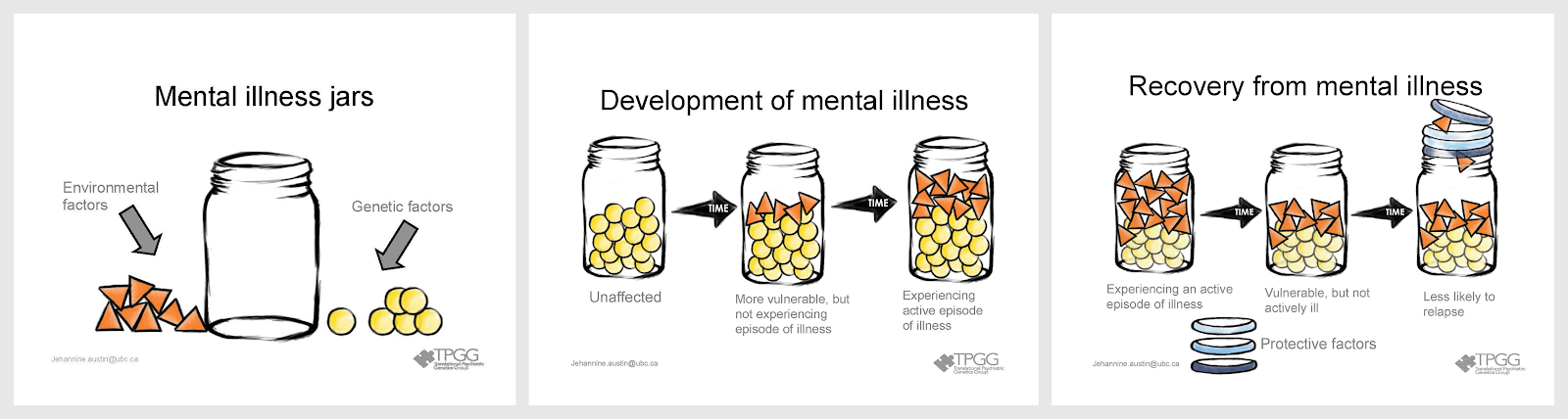
Importantly, we ALL have some genetic vulnerability to mental illness, and that genetic vulnerability doesn’t change. However, we can make our mental illness jar taller by “stacking rings” on top of it, creating more room for environmental factors so that the jar fills up more slowly. The rings on top serve as protective factors against an illness episode, and some of these protective factors (like sleep, nutrition, exercise, good social support) are good for all of us, regardless of our genes. However, some protective factors can be more individual; Alastair talks in the clip about some of his.

“Some protective factors can be more individual”

Genetic counseling is a lot more than just providing people with information about genetics. Genetic counselors can play a really important role in helping families with the emotions they’re facing that can be associated with health conditions they’re living with. We’re also here to help people understand information about how genetics contributes to conditions that run in the family.

“Genetic counselors can play a really important role in helping families”

The jar model is just a tool. It is most impact and effective in the hands of a genetic counselor, and in the context of a personalized genetic counseling session. If you’d like to find a genetic counselor to discuss mental illness or other healthcare questions, you use the Uk’s  Find a Genetic Counselor tool.

This blog is republish of a post from the Genetically Speaking Blog. Read the original here, along with many other fascinating blog posts.

 

Mental health problems in your family do not mean that you will definitely develop a problem too

If you have a family history of a particular mental disorder there is a chance you have some of the genes associated with it. However this doesn’t mean that you will definitely develop that disorder, you just have a genetic predisposition to it. The genetic component to mental disorders is complex and intermixed with a variety of environmental factors which contribute to the development of a disorder. Written by Placement student Emma Bishop and PhD student Rosa Cheesman.

Continue reading

People with mental health disorders can’t just snap out of it

People often believe that those who struggle with a mental illness can ‘snap out of it’ or ‘get a grip’ but this isn’t true. The severity of symptoms can vary both between people and over time, but this doesn’t mean that the mental illness is no longer present. Beliefs like this are probably the result of the stigma that resolves around mental illnesses. In this EDIT Lab blog post, Thalia Eley and placement student Emma bishop discuss the stigma of mental health. 

Continue reading

Studying the causes of mental health helps remove blame within families

Mental health research does not aim to identify a single factor to “blame” for a disorder. Instead, researchers hope to understand the complex interplay of a number of different factors and use this information to generate new approaches to prevention and treatment.

Alicia

Tom


“Our mental health is the result of the interaction of many biological, social and environmental influences.”

Those who have concerns about research leading to all the accountability being placed on one aspect of their life, be it their relationships, lifestyle or biology, may be reassured to know that mental health is very rarely influenced by just one thing. Our mental health is the result of the interaction of many biological, social and environmental influences. Even then, it is not the case that a specific combination of these influences leads to mental health difficulties. Rather, all these factors combine to influence a person’s likelihood to suffer from poor mental health.

This is the principle that most modern research is built upon. Although sometimes studies may focus on one experience that can impact our mental health, it is understood that these experiences do not occur in isolation. It is important to interpret the findings while bearing in mind the other factors that are at play in our lives. For example, even if research were to find that a family factor was associated with mental health, the findings would need to be considered alongside the biological, cultural and social background of the participants. An association between two things does not simply mean that this factor has caused the problem, just that they more commonly occur together.

“Identifying the factors that influence our mental health is also a necessary first step to creating treatments and interventions.”

Identifying the factors that influence our mental health is also a necessary first step to creating treatments and interventions. Researching the biology underlying some mental health conditions has enabled the development of medications that help reduce symptoms. For example, exploring the neural mechanisms involved in emotion processing has helped to identify the benefits of using selective serotonin reuptake inhibitors (SSRIs) in the treatment of anxiety. If relationships between family members are found to influence the likelihood of developing a particular mental health disorder, then this relationship may also be a good place to start when deciding what treatments to offer. For example, many mental health services for young people in the NHS offer family therapy, where family members are encouraged to come along to the sessions so that they can work together to solve things that they are struggling with at home.

In any case, no research finding should lead to blame being placed on family members. As our understanding of genetic influences on mental health conditions is growing, there are some concerns that this could lead to tension between children and their parents. However, it is important to remember that our genetics are what make us similar to our families. Each parent shares approximately half of their genes with their offspring. Finding that genetics plays a role in our mental health should not be viewed as something that could divide families, but as something that can help them to understand each other.


Could you take time off work for your mental health?

It’s 2019 and society is slowly winning the battle against stigma surrounding mental health. NHS posters across London ask commuters “How are you feeling?”, “How is your sleep?” and “Are you able to look forward to things as much as you used to?” – and charity campaigners are working to make sure we’ve all heard that “approximately 1 in 4 people in the UK will experience a mental health problem each year”. But are these campaign messages really sinking in enough to change our behaviour in everyday life? How would you feel if your colleague took a week off work for their mental health, leaving you to cover their job, and would you feel able to do the same?

Continue reading

« Older posts Newer posts »

© 2026 The EDIT Blog

Theme by Anders Norén — Up ↑