Another transition in the NHS – another difficulty in recruiting people to take part in research?

Nathan Davies

by Nathan Davies

Nathan Davies is a PhD student based within the Research Department of Primary Care and Population Health at University College London (UCL). He is working on a palliative care study called IMPACT and here reflects on the difficulties of recruiting general practitioners for the project in light of the changes at the National Health Service (NHS) in England.

IMPACT is a European study working across five different countries: England, Germany, Italy, the Netherlands and Norway. The aim is to improve the organisation of palliative care for people with dementia and/or cancer. In England the project is led by Professor Steve Iliffe from UCL working in collaboration with Professor Sam Ahmedzhai at the University of Sheffield, and Professor Jill Manthorpe from the Social Care Workforce Research Unit at King’s College London. As a researcher on this project I have been part-responsible for the recruitment of various organisations and services to participate in England at a time of massive upheaval and change. What we found was surprising to some extent; however, with hindsight it was not.

I work in a Primary Care research department with strong links to doctors and medical students interested in becoming general practitioners (GPs), yet despite this, our biggest headache in recruitment was in relation to general practice. Why is this? We are not one hundred percent sure and I really don’t think we have the answers about how to improve this; however, I can share some of the difficulties that we encountered. There are several possible reasons, which tend to demonstrate the huge pressures that our GPs are facing at the moment:

Time

GPs have so little time to see their patients, with us all wanting a piece of our GP’s valuable time and often wanting it now. Our GP services are so stretched that we find that fewer and fewer GPs seem to be able to afford the time to do additional work such as research and some struggle to make a home visit as often as would have been expected a few years back. Initiatives requiring GP surgeries to be open later in the evening and seven days a week may increase this sense of busyness. With the new role that some GPs are taking on within Clinical Commissioning Groups they are also having more of their time taken up with this. So when a researcher arrives in a health centre with a new research project, which also demands a piece of their time, then it is not such a surprise they are not quite so able to donate some of their time to work with researchers, despite being enthusiastic about research.

Incentives

Our Primary Care system in the UK rests on a basis of incentives, for example, the Quality and Outcomes Framework (QOF) points system. However, in our project we could not offer very large numbers of points or substantial financial inducements such as these. What we could offer was €1000 per site with additional service support costs, together with hopefully a valuable learning experience which could potentially help improve the organisation and patient service, but this was still not enough. Reflecting upon our attempts I think the closest we came to recruiting GPs was when we were discussing introducing a Locally Enhanced Service, which is again an incentive based system.

Taboo and stigmatization

Within the general public death is still very much a taboo and dementia is still stigmatized. It appeared that many of the GPs that we encountered would rather leave end of life care and palliative care to the specialists. Further to that, many would also rather pass over dementia care to the specialists, such as an old age psychiatrist.

Uncertainty pre–NHS transition

The turmoil over the proposed reorganisation of the NHS before April 2013 caused us huge difficulties. GPs were generally uncertain about what their position would be and therefore questioned whether they could pledge support to a research project which would be an additional commitment.

Confusion post–NHS transition

After April 2013 we still had big problems, indeed probably more problems than before April 2013. Post April 2013 not only were we unable to recruit as many GPs as we needed, we were not even able to arrange meetings or appointments with them to discuss the study. The changes introduced were not a smooth transition. People were left unclear about their roles, responsibilities and how they would go about completing their tasks, balancing a clinical role, commissioning role and for some a research role. Some GPs appeared to be placed in commissioning roles without real choice, and having limited knowledge of that field.

I hope that over the coming months the organisational environment will stabilise and GPs become less anxious, about the new organisations, amended systems, dementia and palliative care. We remain hugely grateful to those GPs and other organisations such as care homes and hospices who have joined this study in these challenging times.

Nathan Davies is a PhD student based within the Research Department of Primary Care and Population Health at University College London.

@ImpactProject1 | @NathanDavies50 | IMPACT website

Compassion and consistency – the key to enabling positive change

Natalie Atkinson

Natalie Atkinson

In this, her second guest post at the Social Care Workforce blog, Natalie Atkinson, a student at the University of Cumbria, updates us on her progress in getting support from her local authority for her studies. There is also news of an upcoming BBC 3 documentary on young people’s experience of the Criminal Justice System and prison. Natalie took part in the Communities of Practice programme: Delivering on the integration agenda for people with multiple and complex needs as an ‘expert by experience’.

Taking part in the ‘Communities of Practice’ research programme run by the Social Care Workforce Research Unit (SCWRU) and Revolving Doors Agency as an expert by experience, has been the start of an amazing year. Having been given the chance to positively use my own ‘lived experience’ to assist in improving front line collaborative responses to people facing multiple needs and exclusions, has given me more confidence to succeed. I never imagined that writing a guest post for the Social Care Workforce blog back in July would play such a huge part in opening doors of opportunity; the power of social media in today’s society is immense. Following on from the guest post I became a contributor for ex-offender.co.uk and was drawn into the world of Twitter; now I am probably classed as a ‘tweeter’.

In November 2013 I finally won my battle with the Local Authority (LA) and received commitment from them to support me through my journey in higher education but more importantly received an apology for how my case had been handled. At the age of 21 I felt that I had been abandoned by Children’s Services when they closed my case and this ultimately made me resent the LA. Yes, Children’s Services have shown compassion and heart in my case, but how many other young people are out there who are not in a position to challenge the decisions that are made about them by different LA’s? Consistency needs to be demonstrated throughout the care system as that is one of the main things a lot of looked after children do not experience. I consider myself to be lucky enough to have the determination and support to challenge decisions.

With only seven months until I graduate with a BSc in Policing, Investigation and Criminology from the University of Cumbria, I still find myself pinching myself to see whether it’s all been a dream. However, the closer I am getting, I am starting to realise that it is reality and this is actually the start of a new chapter in my life. I no longer have to feel ashamed of being a care leaver and an ex-prolific offender because I am actually able to use this to challenge the judgement and prejudices that exist. I can stand as a prime example that you should never give up on a child or a young person and hopefully this will empower individuals, who are in a similar position to one that I have once been in to make changes.

Having left school at such a young age and spending my time snowballing through the Youth Justice System and then the Criminal Justice System (CJS) makes me appreciate the importance of education. A big part of my journey has been returning to education and discovering that I can use my ‘lived experience’ to assist in gaining academic knowledge and I plan to carry on studying and go on to complete an MSc and then a PhD. I have recently been appointed as a Service User Trustee for Homeless Link and I am hopefully able to use my own life experience to campaign for continued and improved support services. One of the biggest opportunities to arise from the guest blog for SCWRU and being a contributor for ex-offender.co.uk has been to use my own experiences as a basis for a BBC 3 documentary on young people’s experience of the CJS and prison, which is due to be aired in April 2014.

Since a young age my life has been like a roller coaster and to this day I still consider my life to be the same but the only difference is, is that I am now part of a positive roller coaster and I get to decide the route I take. I am not able to say for sure what the future will hold for me, but what I do know is that I will always be standing behind the children and young people that are labelled by society; saying if I can do it then so can they. My mission is not to change the world but to challenge the policies and practices that effect children and young people and hopefully one day I might be in a position to influence change.

Natalie Atkinson was an expert by experience on the Communities of Practice programme. Lead researcher at King’s on this project was Senior Research Fellow, Dr Michelle Cornes.

Follow Natalie on Twitter @Nat89atk

Social workers speak out: Remembering our beginnings

Katie Graham, Research Associate at the Social Care Workforce Research Unit, on why we should listen to the recordings of a group of interviews with social workers from the early 1980s.

The Social Care Workforce Research Unit at King’s recently hosted the launch of The WISEArchive Cohen Interviews, a fascinating collection of conversations with 26 social workers reflecting on the early days of the profession. We heard how Alan Cohen during the 1980s had sought out social workers he felt to be pioneers of the profession charting social work activity as early as the 1930s including well-known members of the profession, such as Clare Britton (later Winnicott), Eileen Younghusband, Rose Mary Braithwaite, Enid Warren and Margaret Simey amongst others. These tapes have thankfully been revived, transcribed by volunteers at WISEArchive and edited by Tim Cook and Harry Marsh after 30 years in storage.

Maggie Cohen, herself a social worker, Alan’s partner, shared Alan’s journey through social work, Family Service Units, Social Work lecturing and returning to full-time social work before retiring in 1996. Alan Cohen undertook the interviews with the intention of developing a book, but this did not materialise. Tim Cook described how he and Harry Marsh were invited by WISEArchive to edit, annotate and add context to the interviews with the aim of beginning to realise Alan Cohen’s vision. This work, along with all of the interviews, have now been archived by the Modern Records Centre at the University of Warwick and published online together with the original tapes.

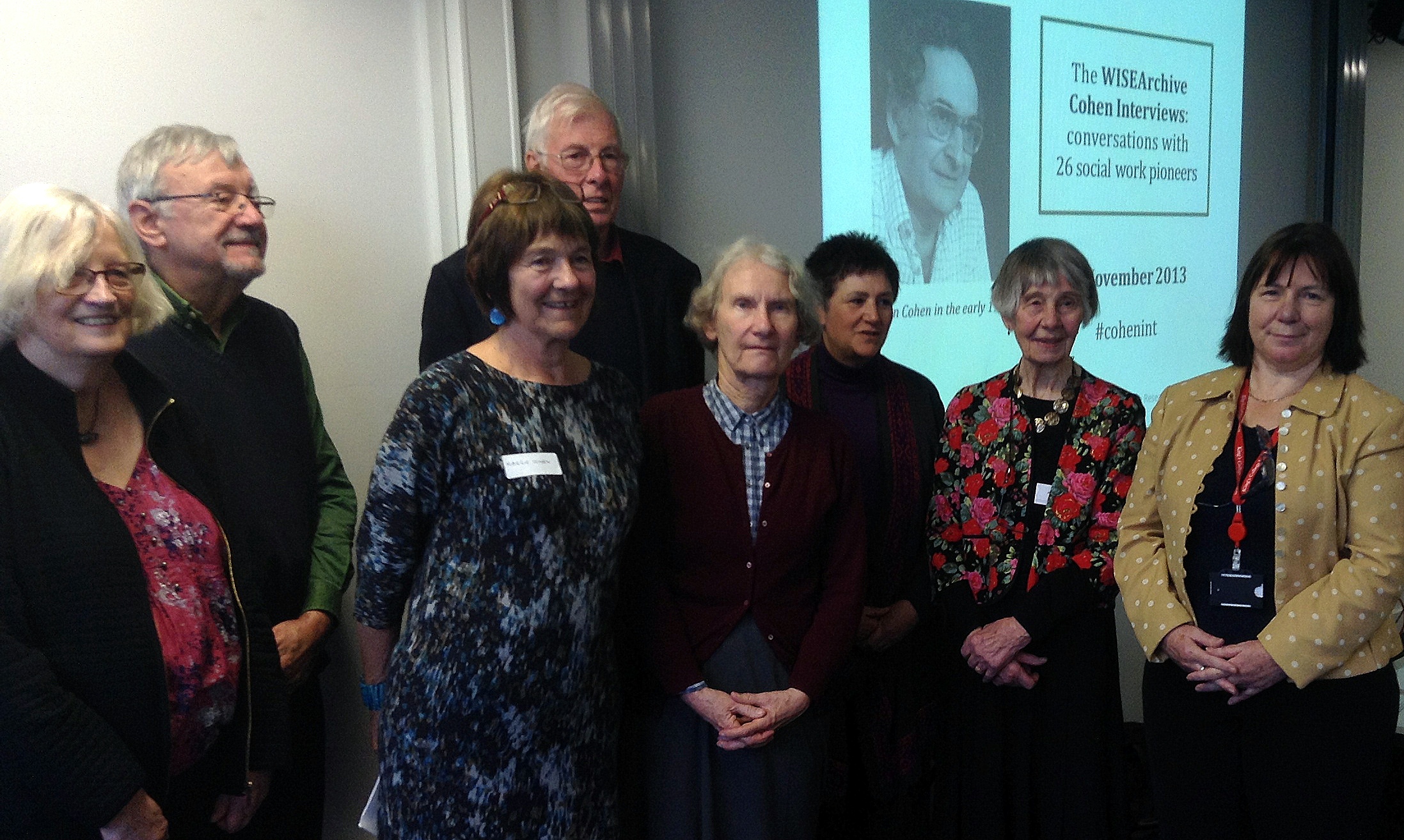
Speakers at the launch of the Cohen Interviews

Participants at the launch on 28 November at King’s (left to right): Olwen Gotts (volunteer transcriber), Harry Marsh (editor), Maggie Cohen, Tim Cook (editor), Barbara Prynn, Helen Ford (Modern Records Centre), Pauline Weinstein (WISEArchive), Professor Jill Manthorpe (King’s College London)

One of the first questions Alan Cohen asked of his interviewees was how and why they chose social work. At the launch event, Pauline Weinstein, the director of WISEArchive, posed the same question to Barbara Prynn. The answer given by Barbara, as I suspect to be the case for many social workers both now and then, is not entirely straightforward and prompted many questions and comments from the audience. Remembrances of social work’s foundation as a negotiation between common sense, practical social work and the ‘psychoanalytical fringe’ and the cycles of policy making and changes in perceptions of ‘good’ and ‘oppressive’ practice. These interviews narrate the forming of ‘Social Work’ as a profession from the formative social sciences course at the London School of Economics (amongst others) and disparate professions of Psychiatric Social Work and Almoners. The coming, going and perhaps coming again (in Scotland at least) of community work, genericism versus specialism in practice as well as more foundational perspectives of the social work role and analysis of the individual and of structural inequalities were also areas of discussion and comment.

Listening to some of these interviews whilst writing this blog I would urge social workers and anyone interested in social work to play the tapes (very easy to do).  When Alan Cohen asked Enid Warren why she became a social worker she described it as, not an active choice, but the result of a ‘process of elimination’.  Geraldine Aves said ‘I had no intention of being a social worker’, but became a social worker ‘very much by the backdoor’ and Clare Winnicott took a long pause before she cited her family’s influence. Although the route into social work may not have been clear, there seemed to be a common thread amongst the interviewees of a determination to do something that could be useful.

Entry into social work is probably rarely uneventful and neither is the career. For myself, the daughter of two social workers, my choice may have been unimaginative. As a social worker I have experienced ambivalence about statutory social work practice this event and these archives offered the opportunity to look back, hear social workers talk about their experiences and dilemmas, and reflect on them in our current situation. The history of social work is a history of change, within, outside and hopefully because of the profession. Drawing on this history during the introduction to the launch of the archives Professor Jill Manthorpe of the Social Care Workforce Research Unit at King’s College London, the host of the launch, positioned this as its strength, adding her personal view that ‘all social workers are pioneers’, members of an evolving and hopefully responsive profession. I left this event in a reflective mood, keen to listen more and would like to thank all involved in making these archives accessible to us all.

Katie Graham is Research Associate at the Social Care Workforce Research Unit at King’s College London. The launch event took place at King’s on 28 November 2013. Those with an interest in social work history may also like to join the Social Work History Network.

@scwru | @wisearchive | #cohenint

All change for social work – shifting the pieces but not the problems?

Dr Mary Baginsky

Dr Mary Baginsky

Dr Mary Baginsky is Visiting Senior Research Fellow at the Social Care Workforce Research Unit. Dr Baginsky, who leads a seminar on 3 December 2013 on Retaining experienced social workers in children’s services, here responds to the comments of the Education Secretary yesterday.

In speaking to the NSPCC on 12 November 2013 Michael Gove MP, the Secretary of State for Education, has pledged to overhaul the child protection system and reform social work training. It is not clear what the former will entail, but there is no mention of the multi-agency approach that has underpinned the system that has come to be known as ‘child protection’. There are references to failing authorities, Birmingham being specifically identified, as well as the success of Hackney. If only everything was so clear-cut. Money was available to achieve the reported transformation of Hackney—a great deal more would be required to do the same in Birmingham and that level of financial support does not seem to be forthcoming at a time when we are told the biggest cuts to council budgets are still to come. In addition we have lost the Children’s Improvement Board just at a time when it is needed to support ‘failing’ and ‘failed’ authorities and facilitate peer support that has been shown to work well.

How many social workers will be saying ‘no more system change for child protection and no more change for initial social work training’? Again it is not clear what is intended for social work training. The Secretary of State says that Step Up has been successful, but not successful enough at recruiting sufficient great people. So would one solution not be to extend the numbers on Step Up instead of supporting another route? But then do we know which people are now being recruited onto courses? Money would be well spent in improving the data sets around social work education so we can move from anecdote and guesswork to a position where we are able to make confident statements.

In the past six years there has been a range of initiatives that have transformed social work education, alongside the recommendations that came from the Social Work Task Force. The money to support many of these has now disappeared, but they have influenced practice and many local authorities are trying to sustain the work. Although based on anecdote it is anecdote that arises from numerous conversations around the country—many local authorities are commenting on the noticeable improvement in the quality of their newly qualified social workers. This is not to say that everything is perfect but we do need to acknowledge the strides that have been made. The really sensible thing would be to try to maintain this improvement and take steps to retain those committed and intelligent entrants who are already coming into the profession. The image that the Secretary of State appears to have of social work education and social work students will not help. Too much listening to the radio programme ‘Clare in the Community’ perhaps—which is so funny because it is so extreme and atypical.

Mary Baginsky is Visiting Senior Research Fellow at the Social Care Workforce Research Unit at King’s College London. She is author, with Claire Teague, of Speaking from Experience: the views of the first cohort of trainees of Step Up to Social Work (Department for Education, June 2013).

Dr Baginsky leads a seminar on 3 December 2013 ‘Retaining experienced social workers in children’s services: the challenge facing local authorities in England’ based on her report of the same title (August 2013)—places still available, attendance is free.

@abbotsky | @scwru

Nearly there? The Care Bill and adult safeguarding

Caroline Norrie and Katie Graham provide an update on the progress of the Care Bill through Parliament with particular reference to its impact on adult safeguarding.

The Care Bill—described as “the biggest overhaul of social care rules for 65 years” (The Guardian, 9 October, 2013)—had its first reading in the House of Commons last week after completing its passage through the House of Lords. The scope of the Bill is extensive, attempting to amalgamate the dispersed and patchy adult social care legislation and including stipulations around social care assessment and funding changes. However, as researchers working on a project about adult safeguarding, we have been following the new adult safeguarding components of the Bill with much interest.

Katie attended the second reading of the Bill on 22 May. Lord Howe presented wellbeing as a central principle of the Bill whilst outlining plans for care funding arrangements (following, though not implementing, all Dilnot’s recommendations), a response to the Francis Report (not including the recommended regulation of social care and health care assistants), a strengthening of carers’ rights and a commitment to place adult safeguarding on a statutory footing.

The principles behind the Bill appeared to be welcomed by many of the speakers that day in the House, although with important caveats. Lord Howe alluded to one of the fundamental difficulties enacting the vision when saying “[a]s a nation we are living longer, which I am sure all noble Lords welcome. Managing the fiscal consequences of this will be a key challenge in the coming years”. Baroness Wheeler brought into stark reality the dire state of local authority funding, highlighting that councils “…by the end of this spending round, will have been stripped of £2.7 billion from their adult social care services, equivalent to 20% of their care budgets, as demand for services increases”.

More recently Caroline attended the House of Lords to listen to amendments tabled at the Bill’s 1st sitting of the report stage on 9 October. Discussions included an amendment which was successfully tabled by the Patron of Action on Adult Abuse, Baroness Greengross, to introduce a duty on councils to provide people with an independent advocate during assessment and support planning if they would otherwise have difficulty in understanding or communicating information, and have no one else to represent them.

Baroness Greengross also proposed amendments aimed at giving social workers powers to obtain court orders to gain access to enter private homes where they suspect a vulnerable adult is being abused but coerced into silence. These amendments were defeated with ministers arguing that existing legal powers were sufficient and social workers needed to improve their skills and knowledge in applying them to protect adults. (Power of entry is already available to social workers in Scotland.)  A survey of The College of Social Work members last year showed strong support for a qualified power of access by a social worker to interview a vulnerable adult where this was being blocked by a third party. Lobbying on this issue continues.

Other elements of the Bill with specific implications for safeguarding practice include:

Enquiries by Local Authorities

The Care Bill proposes a new legal duty for local authorities to make enquiries when they have a reasonable cause to suspect that an adult in their area has a need of care and support, is at risk of abuse and neglect and is unable to protect him or herself. The local authority must make whatever enquiries it thinks necessary to enable it to decide whether any action should be taken in that adult’s case. The Care Bill also confirms, for the first time in law, that “abuse” includes financial abuse. That includes having money or property stolen; being defrauded; being put under pressure in relation to money or other property; and, having money or other property misused. Advocacy organisations including The College of Social Work have been active in lobbying to ensure that people with complex needs are assessed by ‘appropriately qualified staff’.

Safeguarding Adults Boards

Safeguarding Adults Boards are to become statutory and to be composed of multi-disciplinary members. Again, The College of Social Work, amongst others, has been vocal in lobbying to ensure that the local authority representative on safeguarding adult boards should be social work-qualified.

Safeguarding Adult Reviews

The Care Bill proposes local authority Safeguarding Adults Boards must carry out a formal case review if an adult at risk in their area dies in circumstances where abuse or neglect are known or suspected. It must also carry out a review if it suspects that an adult has experienced serious abuse or neglect. Any review must identify the lessons to be learnt from that adult’s case, and apply those lessons to future cases. The stated aim of a review will be to ensure that lessons are learned from such cases; not to allocate blame, but to improve future practice and partnership working, to minimise the possibility of it happening again. With regard to this issue, The College of Social Work has argued for Safeguarding Adult Review teams to “include a social worker with substantial experience of safeguarding work”. Our Unit continues its work on the current system of Serious Case Reviews for adults.

Last week saw the third reading of the Bill in the Lords; a time for tweaking with no major changes suggested. However, there was considerable discussion over an amendment that was tabled, but which after discussion was removed. This focused on safeguarding of vulnerable adults in ‘approved premises’. Lord Patel of Bradford argued that vulnerable people in probation services are not adequately catered for in the Bill and called for a review on “the discharge by probation trusts of their responsibilities for safeguarding adults residing in approved premises” a year after the enactment of the Bill. Lord Patel argued that planned privatisation of probation provision could make it difficult to ensure effective safeguarding provision for those people using probation services. This abandoned amendment raised once more the question of the clarity of roles and responsibilities of all agencies working with people who may be at risk of abuse.

When summing up her contribution to the second reading of the Bill Baroness Campbell said that much depends “on how local authorities choose to implement their responsibilities and powers under this legislation. There is a great danger that this Bill could be ignored as fine words but without teeth”. We await to see what changes, if any, will be made to the Care Bill as it now proceeds through the House of Commons.

Caroline Norrie and Dr Katie Graham are both researchers at the Social Care Workforce Research Unit, King’s College London. They are working on: Models of safeguarding: a study comparing specialist and non-specialist safeguarding teams for adults – currently in its fieldwork stage.

Is a Personal Budget right for you?

Sarah Hamilton, Research Manager at The McPin Foundation, introduces new guides available for practitioners, service users and families getting to grips with Personal Budgets and Direct Payments for people with severe mental illness.

The transformation of social care services and the shift towards personalisation over the last few years has presented many, well discussed challenges for local authorities, social care professionals and service users and their families. In mental health, however, there are specific challenges that need to be addressed. Take up of personal budgets in mental health lags behind other disability groups. In 2012-13, 8.6% of people with mental health problems received self-directed support compared to 27.3% of people with a physical disability and 28.4% of people with a learning disability (HSCIC, 2013).

Is a Personal Budget right for youOur three year research project explored the challenges of introducing personal budgets for severe mental illness in four local authorities. We identified barriers to implementing personalisation that meant that some areas were still struggling to offer personal budgets at all. Chief among these is the difficulty posed by the integration of health and social care, such that personal budgets became the responsibility of both – or sometimes seemingly of neither (Larsen et al, 2013).

Where personal budgets are available, however, other difficulties arise in practice. In the PEOPLE Study we interviewed over 50 people who received, or were applying for, a personal budget to support their mental health, as well as care co-ordinators and families. We found, even among these service users, that there was little awareness of personal budgets, what they are for and how they can be used. The shifting policies and budget cuts of local authorities made it hard for practitioners and service users to get to grips with what was possible. Among many practitioners, patience with these problems had already run out, and we heard how many no longer saw any value in starting a process that was liable to disappoint.

Despite the challenges, however, we also saw how personal budgets and direct payments, when used creatively, could transform lives and give people the determination and the control to manage their lives in the way they wanted. The learning from this research showed how the experience of getting and using personal budgets could be improved, and how practitioners, service users and families can, between them, secure the type of support that makes the biggest difference.

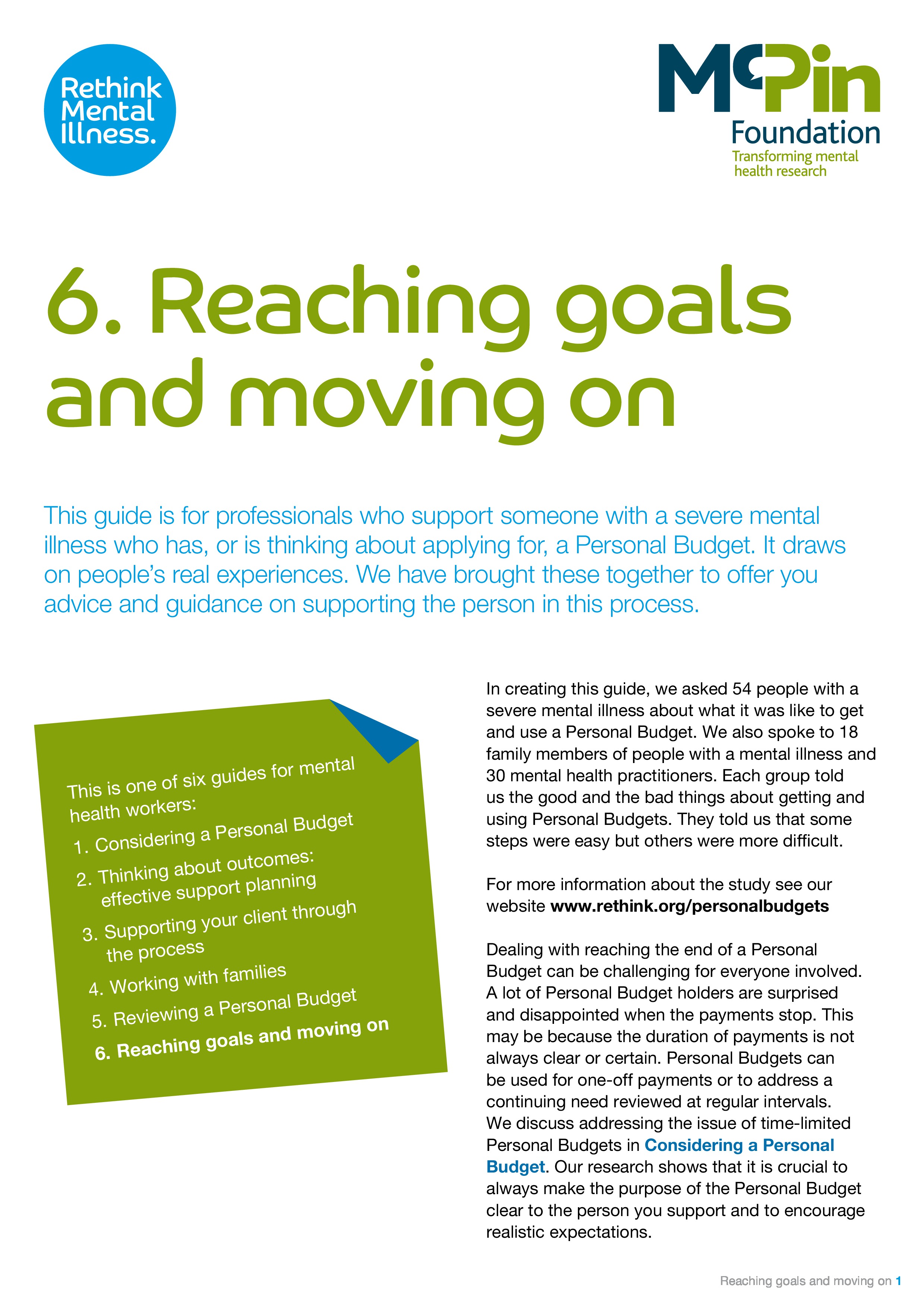
Reaching goals and moving onFrom this research we have produced a series of guides for people with a mental illness, their families, and mental health staff. The guides tell it as it was for the people who shared their stories with us. They point out challenges and offer solutions, and provide examples of what can change for people when it works. They include recorded stories using people’s own words to describe what getting a personal budget was like for them. The guides are freely available to download, use and distribute from Rethink Mental Illness.


The research project which led to the guides was delivered in a partnership between The McPin Foundation and Rethink Mental Illness, with support from Jill Manthorpe of the Social Care Workforce Research Unit (SCWRU), King’s College London, and Jerry Tew of the University of Birmingham. It was funded by the Big Lottery.

Sarah Hamilton is based at The McPin Foundation in London. You can contact her on sarahhamilton@mcpin.org, or visit the Foundation’s website to see more of its work.

@McPinFoundation | @Rethink_ | @scwru

References

Adult Social Care Statistics team, Health & Social Care Information Centre, Measures from the Adult Social Care Outcomes Framework, England 2012-13, Provisional Release, 10 July, 2013.

Larsen, J., Ainsworth, E., Harrop, C., Patterson, S., Hamilton, S., Szymczynska, P. Tew, J., Manthorpe, J. & Pinfold, V. (2013). Implementing personalisation for people with mental health problems: A comparative case study of four local authorities in England. Journal of Mental Health, 22(2): 174-182.

Online dementia training – the future?

In this guest post Professor Rose-Marie Dröes of the Department of Psychiatry at the VU University Medical Centre in Amsterdam relates her experience of developing an online training portal for carers of people with dementia.

It has been a long journey, but our new STAR Training portal was officially launched on 11 October 2013 at the Alzheimer Europe conference in Malta.

This European Lifelong Learning project (known as STAR) has created an online training portal with eight course modules covering the key competence areas for carers of people with dementia. Each module is available at two levels and we hope that the course will serve all kinds of carers, both family carers and professionals. The authors of the course modules are dementia experts from the Netherlands, UK, Sweden and Italy. The project has also included participants from Malta and Romania. Pilots are starting, and anyone can register and try it out.

STAR project

I have learned many things myself in this project, for instance, to really focus on the most relevant themes to include in the course modules so that they will be really useful for family carers and untrained volunteers, but also for professionals.  Also, I have had to learn how to effectively use different web-based interactive strategies to support the e-learning process.

What has been most exciting has been to work together both with dementia experts from different European countries and technology experts who have been able to help us to operationalize our ideas about e-learning for dementia care. This enabled us to compose an e-learning course in different languages and at the same time one that is adapted to different cultures.

But I have also found several things challenging as a researcher. For instance, the writing of the modules, adapting them to the different countries, developing and implementing games, film clips, and tests all took a lot of time. We probably underestimated this in the timeline of the project. As a result we had little time to evaluate the long term effects of the course, that is to say, how it impacts on the knowledge and attitudes of informal carers and professionals. This would be interesting to investigate.

Would I get involved in such a project again? Certainly yes! I think it is very rewarding to be involved in European projects in which educational products and psychosocial interventions are developed and evaluated which in the end may be used in dementia care throughout Europe.

My advice for new researchers, therefore, is to get in touch with international research groups, such as the Interdem network on research into timely psychosocial interventions, and to try to participate in joint international research projects.

Together we can make a much larger impact on innovations in dementia care in Europe.

Professor Rose-Marie Dröes is based at the Department of Psychiatry at the VU University Medical Centre, Amsterdam, the Netherlands: rm.droes@vumc.nl

The Alzheimer Europe conference in Malta at which STAR was launched took place 10-12 October 2013. Twitter hashtag: #23AEC. The conference was also attended by Social Care Workforce Research Unit Director, Professor Jill Manthorpe: see Unit news items.

Personalisation of adult social care – do we have to decide between choice or quality?

Martin Stevens, Research Fellow at the Social Care Workforce Research Unit at King’s, discusses personalisation and the risks associated with an exaggerated concentration on choice in the context of adult social care.

Personalisation of adult social care (and other publicly funded services) is still an important goal of government policy and local practice. The claims about the benefits of personalisation are well known—choice and control produces better outcomes and is achieved primarily through an up-front allocation of resources to individuals to make decisions about what to purchase and from whom. ‘Think Local Act Personal’ is a sector partnership of voluntary and statutory organisations, which offers advice and information to councils and professionals in implementing personalisation and is a leading proponent of personalisation, particularly in relation to personal budgets.

The roots of personalisation lie in two strands of philosophical and political thought. First is a view that markets are the best way (if not the only way) of providing services. Second is an emancipatory perspective that identified professionally organised services as oppressive and restrictive, leading to a campaign for greater control. This was led by young disabled people.

John Clarke and his colleagues (2008) have raised three concerns over the value of emphasising choice in this context. First, they argued that focusing on increasing choice favours those with the best ability to exercise it (or with the most supportive networks), thus increasing inequality. Second, they maintained that a focus on choice ignores the complexities of power relationships and fails to recognise the public interest in decisions about public services, such as social care. Findings from the IBSEN study (evaluating the pilot individual budget sites) also supported this critique (see Stevens et al. 2011). While there has been great emphasis on increasing choice of provider within a market, this has possibly been at the expense of exploring the best ways to support people to exercise choice and control over their lives. Similarly, less attention has been paid to ensuring the quality of the support provided. Some commentators have therefore questioned the extent to which personalised funding should be the sole means of arranging services, arguing for the need for maintaining some collective provision (see Needham 2012).

This is not to argue against choice, but to caution against the adoption of choice as a goal in itself, separate from other aims of improving outcomes. It can be argued that personalisation policy has become focused on the means of choosing services, and how money is spent, rather than the kinds of support that is valued, although Think Local Act Personal has produced some guidance for people using direct payments to employ personal assistants.

The financial recession has led to several years of public sector spending restraint, which has coincided with a strengthening political will towards marketisation. This has become a dominant driver of personalisation. It has exacerbated the emphasis of choice over quality. In practice terms, this presents difficulties for social workers and others working to support people making choices about the use of public money allocated for their support, as there are fewer ‘levers’ to pull in terms of ensuring quality of service and outcomes. Where abuse is suspected, a safeguarding team can investigate and attempt to improve the quality of support if necessary, but this is a safety net approach. It is interesting that two recent evaluations have not emphasised the value of choice in contributing to outcomes, but have highlighted the importance of quality of support (these evaluations were launched at a joint King’s College London and Ipsos MORI event on 25 September (Personalised support services for disabled people: What can we learn?).

Great emphasis has also been placed on the support that disabled people and carers may need to use direct payments. User-led organisations can provide this support and are valued where this happens—see Think Local Act Personal’s guidance document: Best practice in direct payments support – a guide for commissioners. However, there is also a case to be made for professional support for this kind of decision making. Good relationships with individual disabled or older people may be one way of ensuring the availability of advice about the best kinds of support and how to assess the quality of care. Similarly, engagement with organisations of disabled or older people may help to identify concerns and lead to policy and practice questions being addressed. While this support does not necessarily need to be provided by social workers, their value as people trained in understanding the significance of major psycho-social decisions and (hopefully) a good knowledge of the different kinds of support, should not be dismissed.

Dr Stevens is Research Fellow at the Social Care Workforce Research Unit at King’s College London. Recent work includes the Jobs First Evaluation (launched at the 25 September event mentioned in this post). Current work includes Models of safeguarding: a study comparing specialist and non-specialist safeguarding teams for adults.

Follow @MartinStevens2 | Follow @scwru

References:

Clarke, J., Newman, J. and Westmarland, L. (2008) The antagonisms of choice: New Labour and the reform of public services, Social Policy and Society, 7: 2, 245–53.

Needham, C. (2013) Personalized commissioning, public spaces: the limits of the market in English social care services, BMC Health Services Research 13 (Suppl 1): S5 9 pages.

Stevens, M., Glendinning, C., Jacobs, S., Moran, N., Challis, D., Manthorpe, J., Fernández, J-L., Jones, K., Knapp, M., Netten, A., Wilberforce, M. (2011) Assessing the role of increasing choice in English social care services, Journal of Social Policy. 40(2), 257–274.


A new approach to social work recruitment in the United States

Dr Mary Baginsky

Dr Mary Baginsky

Mary Baginsky, Visiting Senior Research Fellow at the Social Care Workforce Research Unit at King’s and an expert on the UK Step Up to Social Work programme, reports on a New York initiative, the Children’s Corps.

I have also come to learn the difference between ‘feeling unsafe and just feeling out of place’. There have been many times when I feel out of place but I am getting over that.—A Children’s Corps Programme member

There is an increasing interest in the United States (US) in trying to ensure that those who are employed in children’s welfare services know what is ahead of them. What have been called ‘realistic job interviews’ attempt to give applicants a deeper insight into what the job entails. They are proving to be reasonably effective where the job is complex or difficult and where there are high turnover rates early on in careers, as well as where aspects of the work may not be fully understood by applicants. By giving them a real idea of the challenges the chances of retaining good staff increase. In the UK many of those recruiting onto social work programmes already do this explicitly or implicitly. We are also seeing some targeting of resources (such as the bursary) at people with prior experience with the idea that this will pay dividends in quality and retention.

The UK Step Up to Social Work programme has now recruited its third cohort. It is targeted at those with a good degree (defined as a first or upper second) as well as significant experience with children and young people. Time will tell what the retention rate is like but the feedback from trainees indicated that their prior experience was invaluable, even if they felt it was not always recognised by the universities or agencies where they were based. On the other side of the Atlantic another similar initiative has also just recruited its third cohort. Once again experience is at the heart of the thinking about how to attract and retain good social workers of the future.

Based in New York, Fostering Change for Children recruits college graduates as well as existing professionals on to the Children’s Corps programme. They all have to be prepared to commit to work in foster care and preventive services in New York City (NYC) for two years. The hope is that many of those who are accepted onto the programme will go on to qualify and practise as social workers. In fact some of those in all three cohorts already have a Bachelors degree in Social Work and see the programme as a way of gaining experience before embarking on a Master’s course. Since 2011, 88 Children’s Corps members have been placed in jobs in foster care agencies and preventive programmes across NYC. The receiving agencies are not expected to provide any additional support and the Corps members are no different from any other employee.

The Children’s Corps programme was inspired by Teach for America and shares its hallmark traits of emphasizing selection, training and support. Its message is that child welfare work is rewarding, but is also complex and demanding; it takes a strong and motivated individual to succeed in the field. The application and recruitment process is rigorous and involves realistic interviewing techniques and resilience testing to try to ensure they get people prepared for tough work in difficult environments. The programme starts with a five-week intensive summer school, but there is no funding to support the participants so they must have or need to find the resources to survive in New York without a stipend. The staff of Fostering Change for Children realise that there is a danger that it will therefore tend to attract those who have enough funds or supportive parents to see them through.

In May I was fortunate enough to be able to spend time with four Corps members while I was in the US as part of my Churchill Fellowship. Two of the four did not fit this profile. One had come to the US from the Caribbean when she was eight and said she had always been encouraged by her mother to give back to the society where they had made their home. She had recently married and the couple was able to live on one salary until she started earning. Another member had borrowed money from her family that she paid back when she started to receive a salary.

While the summer school was said to be excellent they all admitted that they had faced a steep learning curve when they joined their agencies. The average turnover in fostering agencies in NYC is 40 per cent, which meant that those coming towards the end of their second year had seen almost all their original colleagues leave. To say they were dealing with very difficult cases is an understatement and, at times, they had all wondered if they could go on. The quality of the supervision they received in the agencies had varied as this person told me:

For the first nine months of my job when all these workers were leaving it was a very negative work environment – it was not supportive and you were very much on your own. You had seven families assigned to you – I had 19 children assigned as a result. Sometimes I wouldn’t even know what I was supposed to be doing. I had some really old cases that were very hard. I thought about quitting every other day – may be at one point every day. I used to come home late at night after working a 12-hour day and I would cry – I was so exhausted. I did not know how I’d be able to go back the next day. It was very hard.

This person did not quit and is now studying for a MSW. But, as with her colleagues, she attributed her survival to the support she received from Children’s Corps. Not only does each member have a mentor whom they can use as much or as little as they want, the organisation provides monthly training sessions that also offer the opportunity for peer support as well as additional training. The retention level has been good across the early cohorts. Of the four Corps members I met three intended to qualify and practise as social workers and the fourth is deciding between that and going on to become a clinical psychologist, where she admitted she would earn more and probably attract more professional respect. The experience they have gained means that those going into the profession do so with a very realistic expectation of what the work is like. They have also learnt that if they are to stay in the profession they will have to seek out support if it is not immediately available.

Mary Baginsky is Visiting Senior Research Fellow at the Social Care Workforce Research Unit at King’s College London. She is author, with Claire Teague, of Speaking from Experience: the views of the first cohort of trainees of Step Up to Social Work (Department for Education, June 2013). Follow Mary on Twitter: @abbotsky

Go to the Fostering Change for Children websiteChildren’s Corps blog

Dreaming Spires: reflections on the 42nd British Society of Gerontology conference at Oxford

John Miles, PhD candidate with the Centre for Social Gerontology at Keele University and researcher on the Social Care Workforce Research Unit’s Rebuilding Lives study, reports from the British Society of Gerontology conference held earlier this month.

Beginning on Wednesday 11 September around 500 people turned up for the three days of the 2013 British Society of Gerontology (BSG) conference, held this year at Keble College, Oxford, and hosted by the Oxford Institute of Population Ageing. A combination of the Institute’s unique international connections, the prestige of the university itself, and the growing diversity of age-related research, came close to doubling the BSG’s annual attendance. Three linked events drew in well over 100 people in advance on the Tuesday. The turnout required the continuous use of two sites with some occasional overspill on to a few more. Delegates either got an unusual amount of exercise or found themselves grappling with the painfully slow evolution of disability access in a great, listed, Victorian building!

Despite such challenges the conference inspired a great deal of warmth and enthusiasm and its eclectic programme was a constant source of surprise and intrigue. Gerontology is something of a conglomerate, and by its very nature often interdisciplinary. Sessions tended to be grouped by theme rather than discipline, so that a presentation about a survey of 1000 people could be followed by an ethnography of work with ten people in a nursing home. But therein lies some of the conference’s power: as a social gerontologist with sociological inclinations, for example, I found myself in a couple of rich, and productive, post-match discussions with social psychologists. At the ‘Emerging Researchers in Ageing’ event on the Tuesday, cellist Claire Garabedian’s account of her research into playing music to people with dementia was exemplary. She identified herself as a musician and not a therapist. She explained how she had filmed her encounters to supplement and contest her subjective experience of playing one-to-one to individuals in their rooms. She accounted for the complex processes to which her presence in the home gave rise through her dealings with the staff, and with other residents. And she reported a benign impact for many of her auditors.

The cross-currents of such an account with the second plenary at the main conference the following day were significant for me. Literary scholar Helen Small showed four clips from the award-winning documentary Room 335, where the then 19 year-old documentary film-maker Andrew Jencks recorded his stay in a huge Florida nursing home over a period of several weeks. Jencks’ approach might have its drawbacks but it radically demystified the boundaries that supposedly make institutional lives so inaccessible. Moreover, as Small pointed out in a compelling analysis, Jencks’ film established in sociological terms the existence of a robust form of mutual support operating among the residents themselves, none of whom showed any interest in being looked after by their families. Su Su Liu, alongside whom I presented a couple of days later, identified something similar in the outlook of the sixty people she interviewed who attend elders’ community centres in Hong Kong. Friendship among these resilient survivors is more a performance of rhetorical support and social engagement than a pursuit of intimacy or personal trust. In the same session the family sociologist Eric Widmer from Geneva drew on a Bourdieusian perspective to examine the distribution of personal resources within older people’s family networks. This, he argued with me later, is where the social capital that counts is to be found, rather than among the vaguer configurations of ‘community’ into which Robert Putnam’s Bowling Alone has steered so many government-promoted behaviour change initiatives during the last decade. Bola Amaike and Funmi Bammeke from the University of Lagos presented papers about care and support in Nigeria. Their uncompromising demand for men to change their attitudes and expectations underpinned a bold if not quite credible attempt to reconcile the restoration of filial piety with the overthrow of patriarchy!

At the plenary sessions social gerontology itself was interrogated: in its distant relationship to the biological sciences by distinguished stem-cell researcher Paul Fairchild, and to the humanities by Small, and then for being insufficiently ecumenical in its inter-disciplinary relationships at policy level by the World Health Organisation’s John Beard. Whatever the objective justification for these critiques such challenges are welcome and appeared to be well-received. From my perspective, it is our too limited exchanges with economics and political science that remain of greatest concern. Gerontology needs to play a fuller part in challenging government inertia, and contesting destructive corporate agendas, as we plan for, and live in, our ageing society.

John Miles, who works on the Social Care Workforce Research Unit’s Rebuilding Lives study (funded by NIHR School for Social Care Research), has just completed six years on the BSG executive and is a PhD candidate with the Centre for Social Gerontology at Keele University.

Several Unit staff are members of BSG – we organised a symposium on dementia where our mental capacity study work was presented and Unit director Jill Manthorpe chaired a further symposium.