Tag: intergenerational transmission

For the letter G, Thalia [Eley, EDIT Lab director] walks us through gene-environment correlation, a topic we think will become increasingly widely explored as methods for understanding genetic influence improve.

In November 2015 I started working in the EDIT Lab as a Research Assistant (and part-time PhD student), helping to set up a new longitudinal research project in collaboration with the Twins Early Development Study (TEDS). It’s been two and a half years since I started, but what have we done and how far have we come?

WHAT are we working on?
TEDS is one of the world’s premier studies of how genes and environments shape our development from birth to young adulthood. The TEDS team have followed around 10,000 twin pairs since they were born in England and Wales in 1994 – 1995, collecting data from the twins every few years as they grew up. With the help of these twins and their families, the TEDS team have built an enormous dataset relating to child development from birth to young adulthood. The TEDS twins are now in their early twenties and many of them are starting to have children of their own. Our new project, called Children of TEDS (or CoTEDS for short), is designed to follow the children of TEDS twins as they grow up. This means starting the entire TEDS project again from scratch with the new generation of babies. Funding for this project was awarded to my supervisor, Dr Tom McAdams, as part of his Sir Henry Dale Fellowship, jointly funded by the Wellcome Trust and the Royal Society.
WHY are we working on it?
While we collect data on the children of TEDS twins, we are building the world’s first ever twin study to include information on twin parents and their offspring from birth. With a lifetime’s worth of data on two generations, we will research the ways in which different traits are passed down through generations over time, and the roles that parents play during the development of their offspring (see a previous post from Tom on this). We will also be able to examine the impact of parenthood on adult wellbeing, and the ways in which parents respond to their children. It is important that we study the children of TWINS in particular, because identical and non-identical twins provide us with a natural experiment in which we can examine the relative roles of both genes and environments on the transmission of traits from one generation to another (see this paper for a detailed description of the children-of-twins research design). Our research group is especially interested in the ways in which common mental health problems, such as anxiety and depression, run in families.
HOW far have we got?
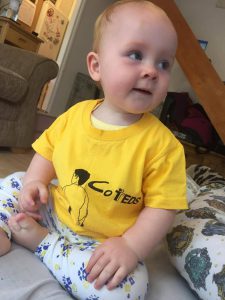
Around 300 TEDS twins have joined the CoTEDS project with their children. So far we have started collecting our first wave of data from the parents of children with a child older than 12 months. Data is collected via questionnaire and we’re asking parents to report on their child’s pregnancy, labour and health, their sleeping, crying, feeding, and development, as well as other aspects of their child’s behaviour such as activity levels and shyness. The questionnaire then asks twins about their parenting behaviour and wellbeing as a parent – which includes questions about the amount of sleep that they are getting and support from other adults. When twins complete this first wave of data collection we send a CoTEDS t-shirt to their child, to say thank you and to welcome our new participants! So far, almost 100 twins with one-year-olds have completed this questionnaire, and another 100 twins with children older than two.


While these twins have been busy completing their first questionnaires, we have been designing the next wave of data collection to be answered by twins after their child turns two. In this wave we repeat many of the questions from the first questionnaire, but this time we also ask twins to play some short games with their two-year-old child. These are the same games that the twins completed with their parents when they were two-years-old through TEDS. So we will be able to compare how well the twins did on the games when they were two, with how their children do on the games now that they are two!
Highlights and challenges?
The first highlight was at the beginning of the project when we started to reach out to the twins to ask whether any of them had become parents. We weren’t sure what to expect but slowly our inbox was littered with photos of children along with excited messages about the new study. The next highlight came about one year later when the first twin completed the first CoTEDS questionnaire, and then again when we received the first photo of a child in their CoTEDS t-shirt!
The biggest challenge has been trying to design questionnaires that will remain relevant for many years to come, for all families and children from all cultures and backgrounds. In TEDS the twins were all the same age and so they all provided data at the same time while they grew up. However, the children of TEDS twins are all being born at different times, and will continue to be born indefinitely for several decades. This means that (if CoTEDS continues to run for as many years as TEDS) twins will continue to complete the same questionnaires about their children for many years to come. How do we predict the kinds of questions that will still be relevant to our research in 15 years’ time? And how will we keep up with collecting data from so many children of different ages, living all over the world? It will be a challenge to work out the logistics for running this recruitment and data collection as our sample size grows, and we will definitely need a bigger team!

Three generations: TEDS twins Jonathan and Catherine with their parents and their children (two of which are also twins!)