Stan Burridge is an ex-rough sleeper and an HSCWRU Peer-researcher. He is Director of Expert Focus, a user-led organisation that supports the involvement of people with lived experience in homelessness research and policy. Here, Stan talks to four ex-rough sleepers about their experiences of living through the Coronavirus pandemic. Names of participants have been changed. (1,825 words)
Like everyone one else, I have watched in fear as the outbreak of the Coronavirus pandemic has sent shockwaves around the world. In the middle of March, I saw the first glimpse of what appeared to be some good news. Hidden in a small paragraph, in the pages of a tabloid newspaper, a caption read, ‘Homeless people to be moved into hotels’. I questioned if this really could be true. Would every homeless person be given a bed, somewhere warm and a place to hide from the pandemic sweeping the nation? Unbelievably, it wasn’t fiction. When the action began it was swift. There were armies of voluntary sector workers lined up, ready for the task which lay ahead to ‘Test, Triage, Cohort and Treat’. Within days, most were moved from the street. But what is happening to people now they are gone from view? Is life all rosy or are there hidden problems which we are not thinking about, not taking care of? I spoke via telephone to four people with ‘lived experience’ of homelessness about their experiences of the impact of Coronavirus and social distancing. This is what they said.
Jane (living in temporary accommodation) Social distancing means that I am basically on my own all the time now. If I do go out it’s only once a week, maybe twice at a push, to get shopping and my medication. Even then, I am staying as far away from people as I possibly can. I am not talking to anyone when I am out unless I have to. The chemist asked me if I minded him signing my prescription because of the risk of catching the virus, all of the staff have face masks and gloves and there is a plastic screen by the counter. Getting stuff from the shops is getting better this week, but at one point because the supermarket didn’t have any toilet rolls I had to walk to another shop, this was a struggle as I am disabled. It was a worthless walk as they wanted £8.99 for two toilet rolls. How am I supposed to be able to pay those prices for ‘bog roll’ when all I get is benefits? I go out really early, about 6 or 7 in the morning so there is no-one else around. I live in a building with lots of bedsits, and I have to use the lift to get out of my building. If there is someone in the lift, I will wait, I won’t get in the lift with them. Luckily, I am on ‘happy pills’ from my doctor which help a bit, but it is draining, and yesterday I couldn’t even muster up the energy go out and get milk because I am getting more depressed each day. I am far away from anyone I know, feeling totally isolated and if I run out of credit on my phone I don’t know what I would do. I’ve got a key worker who is now on limited hours and when he comes to see me we talk through the closed door; he is on the outside in the corridor. I really trust him, but I can’t talk to him about how I am feeling at the moment because other people can hear, it’s not private. It is simple things like this which people forget. Even though I hate what is happening to me and being alone is really getting me down, it is better than sleeping on the streets again. I have seen a beggar – he had a sign asking people not to give him money but to buy him food. How are homeless people going to get fed if they haven’t got any money? I wonder what will happen to everyone who is now in a hotel; will they just get chucked out again, back to the street? Continue reading →

 Richard Griffin MBE,Visiting Senior Research Fellow, King’s Business School, today begins a series of guest posts on the healthcare workforce. He argues that, in the face of the widely acknowledged problem of shortages in this workforce, we should turn to current NHS support staff for part of the solution. (477 words)


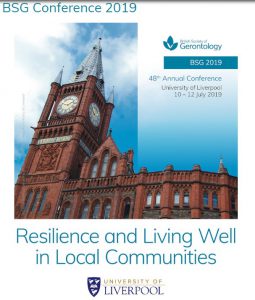 HSCWRU researchers enjoyed two and a half days of stimulating presentations, symposia and keynote speeches at the British Society of Gerontology’s (BSG) 2019 Annual Conference held this year in Liverpool. The 48th BSG annual conference was entitled Resilience and Living Well in Local Communities and took place from 10 to 12th July at the University of Liverpool.