View from the Frozen North

Last July we heard from the Cumbria Registered Social Care Managers’ Network (What can the city banks learn from social care?). At their most recent meeting, Network members discussed issues associated with providing care closer to home. (732 words)

Tim Farron, MP for Westmorland and Lonsdale, braved icy conditions to attend the Cumbria Registered Social Care Managers’ Network on Friday 16 January 2015. The aim of the meeting was to explore from social care mangers’ perspectives some of the challenges of delivering care closer to home. Given the pressures currently facing the hospital acute sector and especially Accident and Emergency Departments, discussions of care closer to home are especially topical as it explores how community health and social care staff can work together to keep people out of hospital where appropriate or to help them come home earlier. Continue reading

What do we know about managers of care homes?

Katharine OrellanaKatharine Orellana is a Research Training Fellow at the Social Care Workforce Research Unit in the Policy Institute at King’s. Katharine’s Care Home Managers: a scoping review of evidence is published today by NIHR School for Social Care Research. (589 words)

We have a tendency to put care home managers at the back of our minds until a crisis hits the headlines. On such sad occasions, there is suddenly a lot of interest in them.

In England, around 460,000 adults live in 17,350 care homes that have a staff body of around 560,000. Care homes are hugely varied in many ways. They range from small, family businesses to large national and multinational chains offering anything from 1 – 215 beds. Homes may cater for more than one group of people, but they all provide accommodation and personal care. Just over a quarter of them also offer nursing, and these account for about half of all places in care homes as they tend to be larger operations. Staff must support residents with increasingly complex needs. Continue reading

Shifting policy attention to the social care workforce

Dr Shereen HusseinDr Shereen Hussein is Principal Research Fellow at the Social Care Workforce Research Unit in the Policy Institute at King’s. (956 words)

The year 2014 has seen growing attention given to the social care workforce, with a number of high profile reviews being published, including the Kingsmill Review ‘Taking Care’, the Unison report into home care ‘Time to care’, the Demos review of residential care and, launched today, the Burstow Commission review on the future of the home care workforce, ‘Key to care’.

The question of how to maintain a high quality social care workforce has received academic scrutiny for many years, with research highlighting the lack of career progression, low pay and status, and the inability of the sector to attract young and diverse groups of workers as some of the key issues. There are many reasons why we are in this state of ‘crisis’ but at the core is the assumption that care work is something that can be performed by ‘anyone’—it does not require a vast amount of skills and we can always find a willing worker to do it. While these assumptions go unspoken, they underline how the sector operates and derive from the perception of care work as ‘women’s’ work that comes ‘naturally’; if the family can do it why do we need a skilled professional to do it? Continue reading

Push and pull: doctors deciding to leave the UK for New Zealand

Stephen MartineauStephen Martineau is a researcher at the Social Care Workforce Research Unit in the Policy Institute at King’s. (670 words)

The Social Care Workforce Research Unit (SCWRU) last week hosted a lecture by Robin Gauld of the University of Otago, New Zealand. Professor Gauld, who is 2014 NZ-UK Link Foundation Visiting Professor, presented new research (done with Dr Simon Horsburgh) on the migration of medical professionals from the UK to New Zealand. Audience members, who included the High Commissioner of New Zealand and the Executive Dean of the Faculty of Social Science and Public Policy at King’s, also heard formal responses from Stephen Bach (Dept of Management at King’s) and Jill Manthorpe, Director of SCWRU. Continue reading

The challenges of medical workforce migration between the UK and New Zealand

Prof Robin GauldOn 29 October 2014 the Social Care Workforce Research Unit at King’s hosts a seminar examining workforce migration in health and social care (places still available). Prof Jill Manthorpe, Director of the Unit, is joined by Prof Stephen Bach, Department of Management at King’s: they will be the formal respondents to a presentation given by Professor Robin Gauld who is the 2014 NZ-UK Link Foundation Visiting Professor. Here, Robin Gauld introduces his work, which focuses on health workforce migration between New Zealand and the UK. (531 words)

The week of 6 October saw significant media coverage in the UK of the 2014 State of Medical Education and Practice report by the General Medical Council. This indicated that around half of all migrating doctors are departing for the shores of Australia and New Zealand. One newspaper summed it up as: ‘…They cost us £610,000 to train – but 3,000 a year are leaving us for a life in the sun…‘. Continue reading

The opportunities and challenges in managing non-UK-qualified social workers in London social work practice

Dr Allen Bartley

Dr Allen Bartley

Are you a registered social worker who has supervised or managed a social work team and who has worked closely for at least 3 months with a non-UK-qualified social worker? If so, Dr Allen Bartley of the University of Auckland would like to hear from you. Dr Bartley, Visiting Research Fellow at the Social Care Workforce Research Unit, is conducting a new study, Crossing Borders: Social work employers’ and managers’ perspectives of migrant social workers. In this call for participants he explains the rationale for the study and how you may be able to help. Interviews are in July.

Background to the study

Social work is a global profession practised in over 140 countries. Its spread and development have been accompanied by a drive to attain professional status and a coherent international identity through the work of a number of international organisations concerned with social work practice and education, such as the International Federation of Social Workers (IFSW) and the International Association of Schools of Social Work (IASSW). The global nature of the profession is reflected in the large number of international professional and academic social work publications and, in Europe, the imperatives of various EU directives and initiatives such as the Bologna Declaration have motivated social work educators and registering authorities to move towards a closer alignment of practice standards to a European norm (Walsh, Wilson & O’Connor, 2009).

That social work as a profession aspires to such a globalized outlook is premised on an assertion that the profession adheres to a central set of values and ethics that transcends national boundaries (Welbourne et al., 2007). Similarly, higher educational programmes in social work across a number of countries now stress ‘universal social work professional values’ such as self-determination, confidentiality, being non-judgemental, acceptance and the respect for diversity (Welbourne et al., 2007; Calderwood, Harper, Ball & Liang, 2009).

As a result, social workers in many countries may feel that they belong to a transnational profession. This perception is reinforced by both government immigration policies and by the global recruitment activities of social work employers. Social work agencies have been actively recruiting and marketing to migrants the benefits of living and practising in the UK, in an effort to fill gaps in its social care system (Hussein, 2014; Christie & Campbell, 2009; Simpson, 2009;). In the UK, between 2003 and 2004 there was an 82 percent increase in the number of overseas qualified social workers entering the country, with the greatest numbers coming from Australia, South Africa and the US (Welbourne et al., 2007), though changes to UK immigration policies more recently have seen a shift towards recruitment from across the European Economic Area (Hussein, 2014). This internationalization of practice has led us to conceptualise social work as inhabiting a transnational professional space (Bartley et al., 2012).

That transnational professional space is not without its challenges. However universal they may be, social work values and ethical codes are always interpreted through the lens of national or regionally-specific historical, social, political and cultural norms (Welbourne et al., 2007; Simpson, 2009). These norms are manifest in a range of challenges that confront transnational social workers: in employment practices and workplace cultures; in negotiating new sets of legislative imperatives and political tensions; and in gaining recognition and acceptance of the validity and transportability of their educational qualifications, skills and practice expertise gained overseas; and in navigating the particular forms of ethnic and cultural diversity and the attendant politics that manifest in local sites and impact on social work practice.

Taking part in the study

As part of the Research On Workforce Mobility network (ROWM) at King’s College London, the Crossing Borders team has partnered with Dr Shereen Hussein, Principal Research Fellow at the Social Care Workforce Research Unit, to replicate in London a study currently underway in Auckland. We plan to interview social work employers and managers in London about their experiences of supervising non-UK-qualified social workers practising in the local context. We will conduct the interviews in London throughout July 2014, or if you are not in London during this time we can arrange for a video or telephone interview.

We would like to hear from you if you are:

  • a registered social worker who has supervised or managed a social work team; and
  • have worked closely for at least 3 months with a non-UK-qualified social worker; and
  • willing to talk about your experiences and reflections.

Please contact: Dr Shereen Hussein to arrange an interview on 020 7848 1669 or shereen.hussein@kcl.ac.uk.

We invite participation from professionals in both statutory, for-profit and voluntary (not for profit) organisations of varying sizes (from very small to very large), and across a range of fields of practice. This study is part of a larger comparative study involving professionals in New Zealand and Australia.

More information: on the Crossing Borders project web page and in the Information Sheet for Study Participants (pdf, 2pp).

Dr Allen Bartley is a New Zealand-trained sociologist who migrated to New Zealand from the United States in 1992. Based in the social work programme in the School of Counselling, Human Services & Social Work at the University of Auckland, he is part of a research team investigating the transnational dynamics of the social work workforce in New Zealand. Additionally Allen is involved in a project exploring the use of social media by migrants in Auckland, and its impact on their sense of identity and belonging. He is Visiting Research Fellow at the Social Care Workforce Research Unit, King’s College London (from July 2014).
Recognising the value of people who are paid to care

Katie Graham, Research Associate at the Social Care Workforce Research Unit, reports on care workers taking strike action in Doncaster.

During the last few months many care workers in Doncaster have been on strike. A three day strike ended on 22 April and union members have now started a further two weeks of action. UNISON members are taking action against changes to pay (including reducing weekend enhancements), sick pay and holiday entitlement. These planned changes are being implemented following the NHS loss of its contract to provide supported living services in the area. Given the rarity of unionisation and action within care work and the precedent that the proposed contract working terms and conditions would set (as more and more previously public sector services are transferred to the for-profit sector), it is curious that there has been such limited national coverage of the ongoing strike action.

In other parts of England social care providers and local authorities (the commissioners or funders of much social care) are subject to sharp criticism over the poor contractual conditions of care workers within commissioned services. Some home care workers have to endure zero hours contracts (Joseph Rowntree Foundation report) and non-payment of travelling time leading to below minimum wage payment. It has been confirmed by Care Minister, Norman Lamb, that there are 307,000 care workers on zero hour contracts (Community Care, 2013); work by this Unit has indicated that at least 150,000 workers in the social care sector may be getting paid less than the minimum wage (Hussein, 2011). And in 2013 the Low Pay Commission expressed its concern that social care workers are particularly vulnerable to poor pay and conditions of employment. The situation has been highlighted in the press and the House of Commons in part due to a recent court verdict in late 2013 (Whittlestone v BJP Home Support Limited) which ruled on the illegality of the non-payment of travelling time.

A recent review of the implications of adult social care budget cuts by Community Care (McNicoll & Stobart, 2014) illustrated the strategies councils are using to manage their limited budgets.  These included increasing the eligibility criteria (threshold for public funding entitlement), strict limits on care packages (e.g. no overnight care and reduction in the length of calls), increasing charges to service users, a ‘cap’ (upper limit) on council expenditure on social care, with budgets allocated to care managers to ensure they ‘understand fully the implications of their decisions’ on finances.  In spite of the government promising guidance for local authorities to address these concerns within the commissioning process another strategy seems to be the outsourcing of previously public run services and the re-negotiation of existing contractual arrangements with voluntary and for profit organisations. These may potentially reproduce the very conditions that have lead the care workers in Doncaster to take decisive action and the difficult decision to strike.

The Joseph Rowntree Foundation (Carr, 2014) recently released a summary of three major research projects looking at care work and low pay. These suggest that the evidence that connects low pay and poor quality of service is inconclusive.  However, it is emphasised that a combination of pay and working conditions including supervision, training, appropriate amount of time to fulfil tasks, need to be considered to ensure ‘job quality’ for the care worker and a quality service.

Historically there has been limited unionisation of care workers working in residential and community services, therefore there has been limited collective response to poor working terms and conditions. The policy of personalisation is leading to the development of a more dispersed and fragmented workforce. This makes the struggle, by those in a position to organise and collectively campaign, particularly difficult and important. By whatever means, there needs to be a wider recognition that ‘care work’ in its multiplicity of forms including practical tasks, assisting, prompting, skill development as well as relationship building, emotional support and developing trust in often intimate domestic situations, should be valued both financially and socially.

Care workers have always experienced low pay for demanding work so little has changed. In recent years we have seen undercover reporters exposing shocking images of abusive practices in residential settings and recently the BBC televised further instances of abuse and neglect of older people in residential care homes by care workers. Many such instances have been rightly responded to both by the criminal justice system as well as the regulator, the Care Quality Commission (CQC). However, there is a problem in individualising the blame (on a ‘bad apple’) rather than seeking to understand and address the systemic failings in how we organise and value front line social care. The combination of dismay at the regular practice of organisations creating savings by non-payment of care workers’ travel time and the ongoing strike action by UNISON members in Doncaster for commensurable terms and conditions of employment in an outsourced service, highlights the need for research and policy to take a holistic view of our care industry, recognising how the material and working conditions of the workforce must be directly connected to the quality of our care services.

Dr Katie Graham joined SCWRU in early 2013 and is working on a NIHR School for Social Care Research funded project comparing the costs and benefits of different models of adult safeguarding.

Social workers speak out: Remembering our beginnings

Katie Graham, Research Associate at the Social Care Workforce Research Unit, on why we should listen to the recordings of a group of interviews with social workers from the early 1980s.

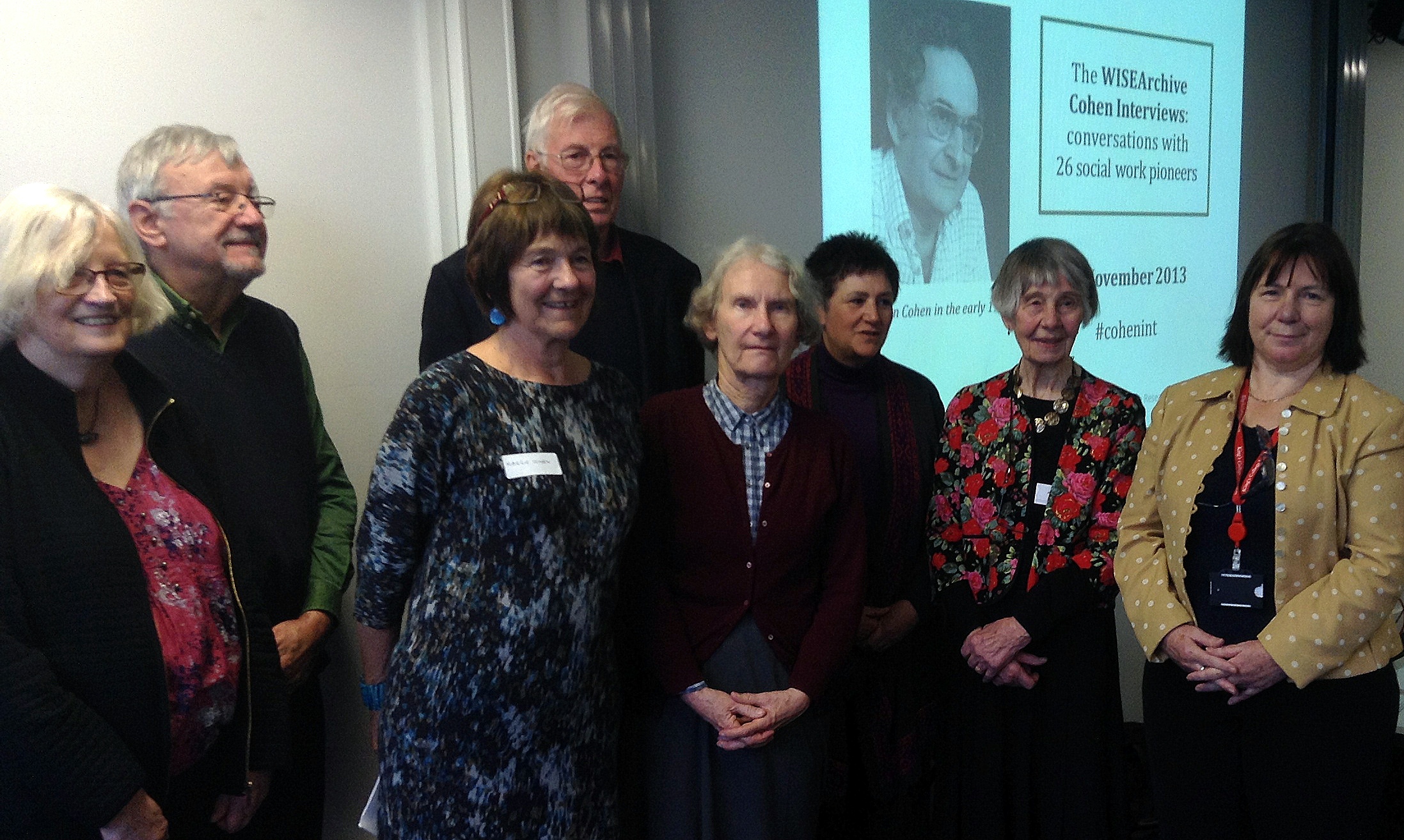
The Social Care Workforce Research Unit at King’s recently hosted the launch of The WISEArchive Cohen Interviews, a fascinating collection of conversations with 26 social workers reflecting on the early days of the profession. We heard how Alan Cohen during the 1980s had sought out social workers he felt to be pioneers of the profession charting social work activity as early as the 1930s including well-known members of the profession, such as Clare Britton (later Winnicott), Eileen Younghusband, Rose Mary Braithwaite, Enid Warren and Margaret Simey amongst others. These tapes have thankfully been revived, transcribed by volunteers at WISEArchive and edited by Tim Cook and Harry Marsh after 30 years in storage.

Maggie Cohen, herself a social worker, Alan’s partner, shared Alan’s journey through social work, Family Service Units, Social Work lecturing and returning to full-time social work before retiring in 1996. Alan Cohen undertook the interviews with the intention of developing a book, but this did not materialise. Tim Cook described how he and Harry Marsh were invited by WISEArchive to edit, annotate and add context to the interviews with the aim of beginning to realise Alan Cohen’s vision. This work, along with all of the interviews, have now been archived by the Modern Records Centre at the University of Warwick and published online together with the original tapes.

Speakers at the launch of the Cohen Interviews

Participants at the launch on 28 November at King’s (left to right): Olwen Gotts (volunteer transcriber), Harry Marsh (editor), Maggie Cohen, Tim Cook (editor), Barbara Prynn, Helen Ford (Modern Records Centre), Pauline Weinstein (WISEArchive), Professor Jill Manthorpe (King’s College London)

One of the first questions Alan Cohen asked of his interviewees was how and why they chose social work. At the launch event, Pauline Weinstein, the director of WISEArchive, posed the same question to Barbara Prynn. The answer given by Barbara, as I suspect to be the case for many social workers both now and then, is not entirely straightforward and prompted many questions and comments from the audience. Remembrances of social work’s foundation as a negotiation between common sense, practical social work and the ‘psychoanalytical fringe’ and the cycles of policy making and changes in perceptions of ‘good’ and ‘oppressive’ practice. These interviews narrate the forming of ‘Social Work’ as a profession from the formative social sciences course at the London School of Economics (amongst others) and disparate professions of Psychiatric Social Work and Almoners. The coming, going and perhaps coming again (in Scotland at least) of community work, genericism versus specialism in practice as well as more foundational perspectives of the social work role and analysis of the individual and of structural inequalities were also areas of discussion and comment.

Listening to some of these interviews whilst writing this blog I would urge social workers and anyone interested in social work to play the tapes (very easy to do).  When Alan Cohen asked Enid Warren why she became a social worker she described it as, not an active choice, but the result of a ‘process of elimination’.  Geraldine Aves said ‘I had no intention of being a social worker’, but became a social worker ‘very much by the backdoor’ and Clare Winnicott took a long pause before she cited her family’s influence. Although the route into social work may not have been clear, there seemed to be a common thread amongst the interviewees of a determination to do something that could be useful.

Entry into social work is probably rarely uneventful and neither is the career. For myself, the daughter of two social workers, my choice may have been unimaginative. As a social worker I have experienced ambivalence about statutory social work practice this event and these archives offered the opportunity to look back, hear social workers talk about their experiences and dilemmas, and reflect on them in our current situation. The history of social work is a history of change, within, outside and hopefully because of the profession. Drawing on this history during the introduction to the launch of the archives Professor Jill Manthorpe of the Social Care Workforce Research Unit at King’s College London, the host of the launch, positioned this as its strength, adding her personal view that ‘all social workers are pioneers’, members of an evolving and hopefully responsive profession. I left this event in a reflective mood, keen to listen more and would like to thank all involved in making these archives accessible to us all.

Katie Graham is Research Associate at the Social Care Workforce Research Unit at King’s College London. The launch event took place at King’s on 28 November 2013. Those with an interest in social work history may also like to join the Social Work History Network.

@scwru | @wisearchive | #cohenint

All change for social work – shifting the pieces but not the problems?

Dr Mary Baginsky

Dr Mary Baginsky

Dr Mary Baginsky is Visiting Senior Research Fellow at the Social Care Workforce Research Unit. Dr Baginsky, who leads a seminar on 3 December 2013 on Retaining experienced social workers in children’s services, here responds to the comments of the Education Secretary yesterday.

In speaking to the NSPCC on 12 November 2013 Michael Gove MP, the Secretary of State for Education, has pledged to overhaul the child protection system and reform social work training. It is not clear what the former will entail, but there is no mention of the multi-agency approach that has underpinned the system that has come to be known as ‘child protection’. There are references to failing authorities, Birmingham being specifically identified, as well as the success of Hackney. If only everything was so clear-cut. Money was available to achieve the reported transformation of Hackney—a great deal more would be required to do the same in Birmingham and that level of financial support does not seem to be forthcoming at a time when we are told the biggest cuts to council budgets are still to come. In addition we have lost the Children’s Improvement Board just at a time when it is needed to support ‘failing’ and ‘failed’ authorities and facilitate peer support that has been shown to work well.

How many social workers will be saying ‘no more system change for child protection and no more change for initial social work training’? Again it is not clear what is intended for social work training. The Secretary of State says that Step Up has been successful, but not successful enough at recruiting sufficient great people. So would one solution not be to extend the numbers on Step Up instead of supporting another route? But then do we know which people are now being recruited onto courses? Money would be well spent in improving the data sets around social work education so we can move from anecdote and guesswork to a position where we are able to make confident statements.

In the past six years there has been a range of initiatives that have transformed social work education, alongside the recommendations that came from the Social Work Task Force. The money to support many of these has now disappeared, but they have influenced practice and many local authorities are trying to sustain the work. Although based on anecdote it is anecdote that arises from numerous conversations around the country—many local authorities are commenting on the noticeable improvement in the quality of their newly qualified social workers. This is not to say that everything is perfect but we do need to acknowledge the strides that have been made. The really sensible thing would be to try to maintain this improvement and take steps to retain those committed and intelligent entrants who are already coming into the profession. The image that the Secretary of State appears to have of social work education and social work students will not help. Too much listening to the radio programme ‘Clare in the Community’ perhaps—which is so funny because it is so extreme and atypical.

Mary Baginsky is Visiting Senior Research Fellow at the Social Care Workforce Research Unit at King’s College London. She is author, with Claire Teague, of Speaking from Experience: the views of the first cohort of trainees of Step Up to Social Work (Department for Education, June 2013).

Dr Baginsky leads a seminar on 3 December 2013 ‘Retaining experienced social workers in children’s services: the challenge facing local authorities in England’ based on her report of the same title (August 2013)—places still available, attendance is free.

@abbotsky | @scwru

A new approach to social work recruitment in the United States

Dr Mary Baginsky

Dr Mary Baginsky

Mary Baginsky, Visiting Senior Research Fellow at the Social Care Workforce Research Unit at King’s and an expert on the UK Step Up to Social Work programme, reports on a New York initiative, the Children’s Corps.

I have also come to learn the difference between ‘feeling unsafe and just feeling out of place’. There have been many times when I feel out of place but I am getting over that.—A Children’s Corps Programme member

There is an increasing interest in the United States (US) in trying to ensure that those who are employed in children’s welfare services know what is ahead of them. What have been called ‘realistic job interviews’ attempt to give applicants a deeper insight into what the job entails. They are proving to be reasonably effective where the job is complex or difficult and where there are high turnover rates early on in careers, as well as where aspects of the work may not be fully understood by applicants. By giving them a real idea of the challenges the chances of retaining good staff increase. In the UK many of those recruiting onto social work programmes already do this explicitly or implicitly. We are also seeing some targeting of resources (such as the bursary) at people with prior experience with the idea that this will pay dividends in quality and retention.

The UK Step Up to Social Work programme has now recruited its third cohort. It is targeted at those with a good degree (defined as a first or upper second) as well as significant experience with children and young people. Time will tell what the retention rate is like but the feedback from trainees indicated that their prior experience was invaluable, even if they felt it was not always recognised by the universities or agencies where they were based. On the other side of the Atlantic another similar initiative has also just recruited its third cohort. Once again experience is at the heart of the thinking about how to attract and retain good social workers of the future.

Based in New York, Fostering Change for Children recruits college graduates as well as existing professionals on to the Children’s Corps programme. They all have to be prepared to commit to work in foster care and preventive services in New York City (NYC) for two years. The hope is that many of those who are accepted onto the programme will go on to qualify and practise as social workers. In fact some of those in all three cohorts already have a Bachelors degree in Social Work and see the programme as a way of gaining experience before embarking on a Master’s course. Since 2011, 88 Children’s Corps members have been placed in jobs in foster care agencies and preventive programmes across NYC. The receiving agencies are not expected to provide any additional support and the Corps members are no different from any other employee.

The Children’s Corps programme was inspired by Teach for America and shares its hallmark traits of emphasizing selection, training and support. Its message is that child welfare work is rewarding, but is also complex and demanding; it takes a strong and motivated individual to succeed in the field. The application and recruitment process is rigorous and involves realistic interviewing techniques and resilience testing to try to ensure they get people prepared for tough work in difficult environments. The programme starts with a five-week intensive summer school, but there is no funding to support the participants so they must have or need to find the resources to survive in New York without a stipend. The staff of Fostering Change for Children realise that there is a danger that it will therefore tend to attract those who have enough funds or supportive parents to see them through.

In May I was fortunate enough to be able to spend time with four Corps members while I was in the US as part of my Churchill Fellowship. Two of the four did not fit this profile. One had come to the US from the Caribbean when she was eight and said she had always been encouraged by her mother to give back to the society where they had made their home. She had recently married and the couple was able to live on one salary until she started earning. Another member had borrowed money from her family that she paid back when she started to receive a salary.

While the summer school was said to be excellent they all admitted that they had faced a steep learning curve when they joined their agencies. The average turnover in fostering agencies in NYC is 40 per cent, which meant that those coming towards the end of their second year had seen almost all their original colleagues leave. To say they were dealing with very difficult cases is an understatement and, at times, they had all wondered if they could go on. The quality of the supervision they received in the agencies had varied as this person told me:

For the first nine months of my job when all these workers were leaving it was a very negative work environment – it was not supportive and you were very much on your own. You had seven families assigned to you – I had 19 children assigned as a result. Sometimes I wouldn’t even know what I was supposed to be doing. I had some really old cases that were very hard. I thought about quitting every other day – may be at one point every day. I used to come home late at night after working a 12-hour day and I would cry – I was so exhausted. I did not know how I’d be able to go back the next day. It was very hard.

This person did not quit and is now studying for a MSW. But, as with her colleagues, she attributed her survival to the support she received from Children’s Corps. Not only does each member have a mentor whom they can use as much or as little as they want, the organisation provides monthly training sessions that also offer the opportunity for peer support as well as additional training. The retention level has been good across the early cohorts. Of the four Corps members I met three intended to qualify and practise as social workers and the fourth is deciding between that and going on to become a clinical psychologist, where she admitted she would earn more and probably attract more professional respect. The experience they have gained means that those going into the profession do so with a very realistic expectation of what the work is like. They have also learnt that if they are to stay in the profession they will have to seek out support if it is not immediately available.

Mary Baginsky is Visiting Senior Research Fellow at the Social Care Workforce Research Unit at King’s College London. She is author, with Claire Teague, of Speaking from Experience: the views of the first cohort of trainees of Step Up to Social Work (Department for Education, June 2013). Follow Mary on Twitter: @abbotsky

Go to the Fostering Change for Children websiteChildren’s Corps blog