Family psychologist and parent, Bonamy Oliver, discusses how messages about parenting could be impacting children and young people.

Bonamy Oliver
Research on the development and treatment of emotional disorders, discused and digested by the EDIT Lab Team and collaborators
Bonamy Oliver
Jehannine Austin, Ph.D., CGC, is a past president of the National Society of Genetic Counselors and is a professor in the Departments of Psychiatry and Medical Genetics at the University of British Columbia in Vancouver. In this blog she discusses how people can help protect their mental health when they may have a genetic vulnerability to mental illnesses.

While many people know that genetic counselors work with families concerned about conditions caused entirely by genes, people are often less familiar with the idea that we also work with families affected by health conditions caused by a combination of genes and our experiences. Psychiatric disorders such as schizophrenia, depression, anxiety and bipolar disorder are a few examples.
As a genetic counselor who specializes in psychiatric disorders, I help people understand what we know about how these conditions can result from combined experiences and our genes. I love doing this because we can use this knowledge of how these conditions arise to manage our mental health for the future – and that can be really impactful for people.
“Conditions can result from combined experiences and our genes”
The short video clip below is from a documentary that aired in the UK in May 2019. I provided genetic counseling about depression for Alastair Campbell, who’s best known for his work as Prime Minister Tony Blair’s spokesman and campaign director. The clip shows the part of the genetic counseling session where I am helping Alastair understand how genes and our experiences work together to cause depression. As you will see, this had quite an impact for Alastair.
Why do some people get depressed?
The jam jar analogy is a helpful way of understanding why some people suffer from mental illness. @campbellclaret pic.twitter.com/t87SqZetgl
— BBC Two (@BBCTwo) May 21, 2019
The analogy I use in the clip is that we all have a “mental illness jar.” In order to be actively experiencing an episode of illness, the jar must be filled to the top. Different people’s jars can become filled with different amounts of genetic and environmental (or experiential) vulnerability factors. An environmental factor might be job stress, financial concerns, family issues or personal loss.
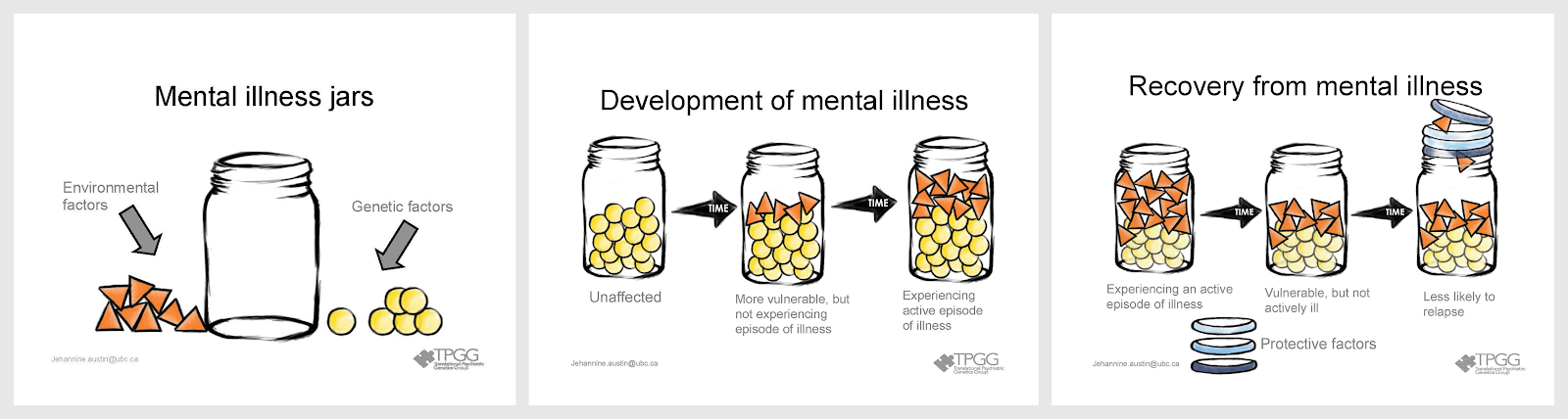
Importantly, we ALL have some genetic vulnerability to mental illness, and that genetic vulnerability doesn’t change. However, we can make our mental illness jar taller by “stacking rings” on top of it, creating more room for environmental factors so that the jar fills up more slowly. The rings on top serve as protective factors against an illness episode, and some of these protective factors (like sleep, nutrition, exercise, good social support) are good for all of us, regardless of our genes. However, some protective factors can be more individual; Alastair talks in the clip about some of his.
“Some protective factors can be more individual”
Genetic counseling is a lot more than just providing people with information about genetics. Genetic counselors can play a really important role in helping families with the emotions they’re facing that can be associated with health conditions they’re living with. We’re also here to help people understand information about how genetics contributes to conditions that run in the family.
“Genetic counselors can play a really important role in helping families”
The jar model is just a tool. It is most impact and effective in the hands of a genetic counselor, and in the context of a personalized genetic counseling session. If you’d like to find a genetic counselor to discuss mental illness or other healthcare questions, you use the Uk’s Find a Genetic Counselor tool.
This blog is republish of a post from the Genetically Speaking Blog. Read the original here, along with many other fascinating blog posts.

If you have a family history of a particular mental disorder there is a chance you have some of the genes associated with it. However this doesn’t mean that you will definitely develop that disorder, you just have a genetic predisposition to it. The genetic component to mental disorders is complex and intermixed with a variety of environmental factors which contribute to the development of a disorder. Written by Placement student Emma Bishop and PhD student Rosa Cheesman.
© 2026 The EDIT Blog
Theme by Anders Norén — Up ↑