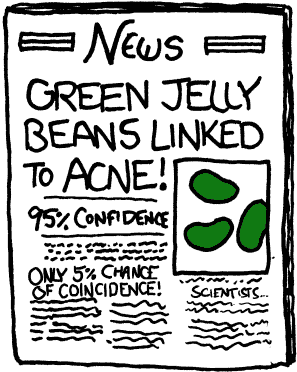
This week for our S blog, we bring a post on the important issue of statistical significance, written by a guest blogger from the Said & Dunn blog, led by Dr Erin Dunn. This post is by Khalil Zlaoui, a graduate student in the Dunn Lab. We are very grateful to him for sharing this content with us. The standard measure of statistical significance in science (i.e. whether you believe a result is true) is when your effect is associated with a p value of less than 0.05. What this means is that you would expect that finding by chance no more than one in twenty times. Here Khalil discuss various problems with that approach and suggestions that have been made to address them.
Author: EDIT Lab guest contributor (Page 6 of 9)

In this post Robert Chapman [PhD student at Goldsmiths, University of London] contemplates what the future holds for the long-awaited genetic revolution.

At the end of her last blog post, Laura briefly touched upon how as well as working on the stigma surrounding mental health, a lot also needs to be done within Minority Ethnic communities. Having recently attended another talk at King’s College London: Diversity & Psychiatry: Old Battles and New Findings, she’ll now go more in-depth on the ethnic inequalities in mental health and how this issue is being tackled.
In this post Professor Alice Gregory [EDIT Lab collaborator and former PhD student] discusses the aetiology of sleep problems – giving us a taster of what to expect from her book, ‘Nodding Off: The Science of Sleep’

This week on the blog Kara writes about conduct problems and the importance of identifying and understanding differing aetiologies and trajectories across through the lifespan. Continue reading
Today we have some reflections from Dr Holan Liang, part-time Consultant at Great Ormond Street Hospital and Honorary Senior Clinical Lecturer at UCL, on her journey through academia, motherhood, writing and part-time clinical work in medicine. You can follow her on Twitter on @shrinkgrowskids.

Following on from April’s stress awareness month, Megan discusses stress in the context of gender dysphoria, and provides information on how to help those that may be suffering.

Around 1 in 4 people in the UK will experience a mental health problem every year (MIND), yet despite it being so prevalent, about 90% of those with mental health problems report having to face some form of stigma – whether that’s from their friends and family, work, education or during treatment (Time to Change). Laura writes about a talk she attended, which discussed whether the methods we’re currently using to tackle this issue are actually working.
Next year, the average British person will check their phone more than 10,000 times and 4,000 of these will be made compulsively. Facebook. Instagram. Snapchat. Most of us have an account on at least one of these social media platforms and they often play a big part in our lives. However, the effect these websites have on our mental health is now being questioned. Laura [EditLab placement student] tells us why.