Toolkit for reflection on human rights in the context of social care

Caroline Green is Post-Doctoral Fellow at the Policy Research Unit in Health and Social Care Workforce, King’s College London. (709 words)

During the COVID-19 pandemic, the importance of human rights for people needing care and support in care homes or at home, their carers, families and friends became evident. Care home residents, especially people with dementia, were one of the groups who were and still are most severely affected by the virus, with thousands of deaths from a COVID-19 infection not only in England but many countries around the world. The need to protect people requiring care and support and to balance infection control – thus the basic rights to health and life – with the right to a private and family life and to social participation was but one of many examples of a human rights issue that we as a society had to face during this pandemic. Conversations around these topics are often difficult.

Human rights as enshrined in international and national law, notably the Human Rights Act, are directly relevant to people requiring care and support, service providers and care workers. Not only is every human being entitled to have his or her rights respected, protected and implemented but the English legal and regulatory system for care providers also makes them directly relevant in care settings. However, human rights are more than a legal concept. They are also a moral concept, which can help to build a social care system and determine the way care is provided. Human rights in social care is therefore a broad topic, with many different ways of approaching it in conversations, training and research. Continue reading

Three early papers on self-neglect

At the NIHR Policy Research Unit in Health and Social Care Workforce we are undertaking two studies examining self-neglect, both funded by the NIHR School for Social Care Research. In an article published in The Journal of Adult Protection, for the project examining Adult Safeguarding Responses to Homelessness and Self-neglect, Stephen Martineau goes back to three pioneering research papers on self-neglect to consider what, if anything, they can feed into current debates. (787 words)

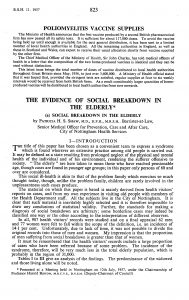
Patricia Shaw's contribution in the 1957 paper on ‘social breakdown in the elderly’

Patricia Shaw’s contribution in the 1957 paper on ‘social breakdown in the elderly’

While conducting a review of the self-neglect literature during this year, references to two early papers on the topic have come up repeatedly. The first, published in the British Medical Journal in 1966, by Macmillan and Shaw, is often described as the seminal academic paper in this field and drew on cases in Nottingham. The other is the Diogenes Syndrome article, by Clark, Mankikar and Gray, published in The Lancet in 1975; it derived from a study conducted in a Brighton hospital. Our new Journal of Adult Protection article examines these two articles plus a third, again by Shaw and Macmillan. This one dates from 1957 and, though it did not use the term self-neglect (rather, social breakdown in the elderly), it is the most vivid and interesting of the three.

There is a good deal of research interest in self-neglect at present. Following consultation with, and a survey of, practitioners, carers and service users (suggested by our Unit), the James Lind Alliance (2018) Priority Setting Research Partnership on Adult Social Work recommended that the topic should be a research priority. As well as the Unit’s two studies (details below), the NIHR has a call out for a study of self-neglect in the community (closing 28 January 2021). The need for such research is reinforced by Michael Preston-Shoot and colleagues’ new national study of Safeguarding Adults Reviews that were conducted between April 2017 – March 2019. SARs are commissioned where questions are raised about the way agencies involved in safeguarding have worked together in individual cases: among the 231 reviews the authors analysed, self-neglect constituted the most common type of abuse/neglect (featuring in 45% of the reviews). Continue reading