Research on the development and treatment of emotional disorders, discused and digested by the EDIT Lab Team and collaborators

Tag: Treatment

T for Treatment

Evidence-based psychological treatments are now widely available within the NHS. In this blog, we explore the profound impact and potential of the Talking Therapies programme in effectively managing common mental health disorders.

Nour, PhD student

Meg, Postdoctoral Research Associate


Anxiety and depression are common mental health conditions that affect a significant portion of the population¹. Prompt identification and treatment are crucial. Fortunately, there are evidence-based pharmacological and psychological treatments for these conditions. Both types can be effective, however, many patients express a preference for psychological treatment².
https://www.southwestyorkshire.nhs.uk/2023/04/17/a-new-name-for-improving-access-to-psychological-therapies-iapt-services-2/


In 2008, NHS England launched the Talking Therapies programme (formerly known as Improving Access to Psychological Therapies, or IAPT) to make evidence-based psychological treatments more accessible for individuals with common mental health disorders³. You may have heard people speak of psychotherapy, therapy or counselling – ‘talking therapies’ is another term for these treatments. The NHS Talking Therapies programme focuses on psychological treatments recommended by the National Institute for Health and Care Excellence (NICE) and individuals can self-refer or be referred by their GP.

Treatment begins with an initial assessment, during which patients discuss their concerns, symptoms, and therapy goals with a trained therapist. This helps tailor the treatment plan to the individual’s unique circumstances. NHS Talking Therapies services follow a stepped-care approach whereby patients initially receive the least intensive suitable treatment and can subsequently be stepped up or down, as necessary. An example of a low-intensity treatment is self-help guided by a mental health professional. High-intensity treatments include talking therapies such as cognitive-behavioural therapy. The length and duration of therapy vary depending on factors such as condition severity, individual progress, and overall goals. Some individuals may benefit from short-term therapy with a specific number of sessions, while others may require longer-term support.


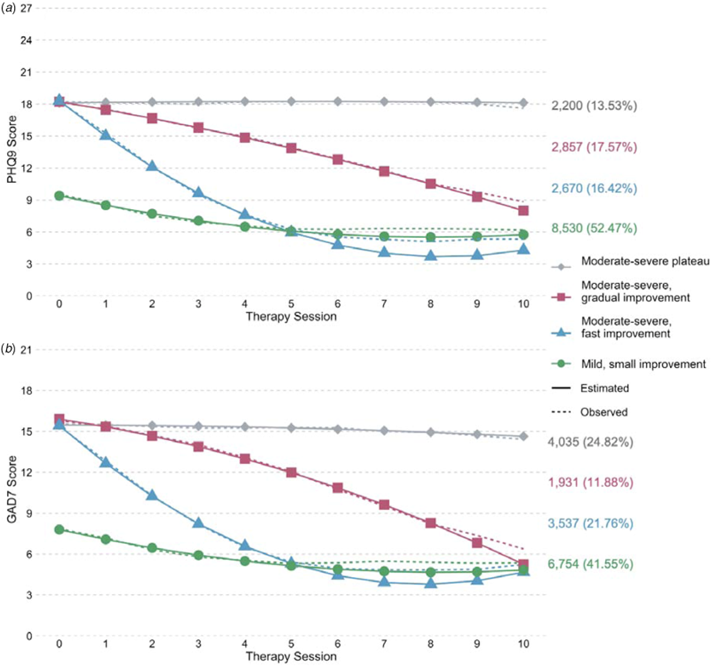
From April 2021 to March 2022, NHS Talking Therapies received over 1.8 million  referrals4.  Of the patients who received treatment, approximately 50% achieved recovery, such that their symptom levels transitioned from above clinical case thresholds to below. Furthermore, over 60% of patients experienced reliable reductions in their symptoms.

It’s important to acknowledge that there is still a long way to go before treatment becomes suitable for everyone. Recovery rates remain lower than desired, leaving ample room for improvement. Inclusivity in mental health treatment is one aspect that requires attention. Currently, psychological therapies primarily focus on existing evidence-based approaches that may not be suitable or culturally appropriate for everyone. Recognising and catering to the diverse needs and backgrounds of patients is necessary to ensure accessible and relevant treatment options. Another significant issue is the average waiting times for treatment within the service. Timely intervention is crucial for avoiding further distress and potentially worsening of symptoms, yet some services experience lengthy waiting times. This is likely attributable to the imbalance between the demand for these services and the number of therapists. Prioritising reduced waiting times is essential to ensure individuals receive care when needed.

The availability of psychological treatments within the NHS is crucial for improving mental health care for individuals struggling with anxiety and depression. These evidence-based therapies enable patients to work with skilled professionals to develop effective coping mechanisms, challenge negative thought patterns, and ultimately enhance their overall well-being and quality of life. 


If you have been experiencing symptoms of anxiety or depression, visit your GP to discuss your options. There are many useful services online, such as information on local peer support groups and self-help techniques, as well as confidential helplines if you want someone to talk to. We have listed some of them below. There are also more specialised services, for example for LGBTQ+ individuals, or that are faith and culturally sensitive. 

Samaritans (Confidential support for people experiencing distress, struggling to cope, or at risk of suicide)
www.samaritans.org.uk Phone: 116 123 (free 24-hour helpline)

Mind (Mental health charity providing advice and support as well as raising awareness).
http://mind.org.uk/ Phone: 0300 123 3393 (local rate, Mon – Fri 9am – 6pm)

Peer support group https://www.mind.org.uk/information-support/side-by-side-our-online-community/

England: Find your local NHS Talking Therapies (self-referral possible, CAMHS services available for under 18s)

https://www.nhs.uk/service-search/mental-health/find-an-nhs-talking-therapies-service 

Outside of England, speak to your GP about referral to mental health services. 

Wales:
https://bcuhb.nhs.wales/health-advice/mental-health-hub/silvercloud-free-online-mental-health-therapy/ 

https://www.mind.org.uk/get-involved/supported-self-help/ 

Scotland:

https://www.samh.org.uk/find-help

https://www.citizensadvice.org.uk/scotland/health/nhs-healthcare-s/mental-health-s/ 

Northern Ireland: 

https://www.mindingyourhead.info/ 

https://www.ocduk.org/overcoming-ocd/accessing-ocd-treatment/accessing-ocd-treatment-through-the-nhs/northern-ireland/ (the treatment pathway is similar for anxiety and depression)


References:

  1. McManus, S., Bebbington, P., Jenkins, R. & Brugha, T. Mental health and wellbeing in England: Adult psychiatric morbidity survey 2014. (2016).
  2. McHugh, R. K., Whitton, S. W., Peckham, A. D., Welge, J. A., & Otto, M. W. (2013). Patient preference for psychological vs pharmacologic treatment of psychiatric disorders: a meta-analytic review. The Journal of Clinical Psychiatry, 74(6), 595–602.
  3. Clark, D. M. (2011). Implementing NICE guidelines for the psychological treatment of depression and anxiety disorders: the IAPT experience. International Review of Psychiatry, 23(4), 318–327.
  4. Population Health, Clinical Audit and Specialist Care Team & NHS Digital. (2022) Psychological Therapies, Annual report on the use of IAPT services, 2021-22. https://digital.nhs.uk/data-and-information/publications/statistical/psychological-therapies-annual-reports-on-the-use-of-iapt-services/annual-report-2021-22 
Dog Years: Author interview about living with depression

This week we talked to Kaye Blegvad, author of the incredible “Dog Years: An illustrated Book About Mental Health”  her experience of living with depression, including friendships, genetics and stigma.

Thalia-Eley-200x280-150x150MSC Genes Group 2016-17-33 (2)


How did you come up with the idea of a naughty black dog to represent your depression?

I wish I could say the black dog as a metaphor was my idea, but it’s actually a really old one – apparently it dates back to Roman times. I knew of it from quotes by Winston Churchill, who referred to his own depression as a black dog. I remember hearing it as a teenager, and it really stuck with me. I find it helpful sometimes to use metaphor when trying to explain these fairly abstract feelings – describing depression in simple terms is pretty challenging, and getting some distance from the emotions can help make it clearer to others, as well as helping me understand the situation better myself.


How did your black dog affect your friendships when you were a child and then later as a teenager and now and adult?

I was a pretty insular child. I had friends, but I often felt on the outside of the group, and spent quite a lot of time alone. As a  
teenager I had several pretty intense friendships, and often with other people who’d also struggled with depression or similar issues, with whom I didn’t have to explain. But the main impact I think that depression has had on my friendships is to do with the ability to socialize, as it forces you into a world that’s slightly separate from others. At times it has felt impossible to reach out to friends, or even leave my room. Most often it is that depression sucks every ounce of energy, and it feels like I can’t “afford” the energy required to see people, even if I would love to. So I have often been quite an absent or unreliable friend. On the whole, I’ve been lucky that my friends are understanding.

Do you wish that your family/friends had known about your dog sooner?

I talked to my parents about it pretty much as soon as I understood that something felt definitely “wrong” – it wasn’t just teen angst, I was really feeling things that weren’t normal at all. I’m lucky that my parents were understanding and took me seriously. I’ve also always been pretty open about it with friends – as a teenager I would say I was an over-sharer to my close friends. So I don’t think there was much of a delay between me realizing about the dog, and others knowing about it too.

We were interested to hear that you feel you were born with your dog. Our team explores the role of genetic factors on depression, and on treatment response. Do you have views about whether and how such information should be used?

I certainly don’t know much about the scientific basis of being born with a dog. But I do feel that there is something intrinsic in
me that makes me prone to this – perhaps I am inherently depressive, but not necessarily inherently depressed. My family has a long history with depression, and some of that feels pretty likely to be genetic. Also, I’ve never felt like my depression was really “about” anything. It has always been amorphous and abstract, which makes it feel like it comes from within, rather than from outside sources. I know depression is different for everyone, and some people certainly have a concrete “root” to it, whereas others seem more chemical based. If a certain type of treatment can help even a few sufferers, that seems worth pursuing to me.

Are there any signs that indicate someone that is good/bad for your dog?

I guess it’s much the same as people who are good/bad for you in general. I think I’ve gotten better at identifying certain things that don’t mix – beyond avoiding people who just seem explicitly cruel, which is a bit obvious, there are people who have behaviours which are triggering,  or who just aren’t very sensitive or interested in the feelings of others. If somebody gets offended or angry when I have to cancel a plan due to depression, or double check the details due to anxiety, it’s probably just going to become a spiral.

Do you feel like there is less stigma around mental health?

lt does feel like the stigma is reducing. I don’t know if that’s because I’m getting older and therefore the people I’m around have more life experience and are more likely to understand, or if there are real shifts in social perception. I’d like to think the latter. I have appreciated seeing many awareness campaigns and movements about it in recent years, and I’m sure that’s having an impact. For myself, the more I’m aware of how many people suffer in similar ways, the less self-conscious I feel about having my own dog tagging along.

Has this stigma had an effect on your depression?

I think the stigma gets internalized, and I probably view myself through that lens more than other people do. It reinforces low
feelings and can cause a spiral. I had a (bad) therapist tell me “depression isn’t very attractive” once, and that feels like it’s written in neon lights everywhere when I’m feeling bad.

 Do you have any advice for young people out there who are wondering where to turn?

My main advice is just: tell someone, ask for help. Do not be afraid to reach out. See a therapist if you possibly can. Do not keep the feelings inside. And remember that you are not alone – those words might seem empty but try to really feel them. There are countless people out there who know what you’re going through, who will understand you, and even if you don’t know them yet, you will find them.

Is there anything you’d have liked someone to tell you when you first began to recognise you were suffering from depression?

Hmm. This is hard. I can think of what I’d have liked people not to have told me, which is “it’s just a phase”. A lot of people tried to dismiss it as hormones or teenage angst, which set me back quite a lot in feeling like I would actually be able to get effective help. I knew perfectly well that what I was experiencing was not what most of my peers were experiencing. But it took quite a while to have adults believe that that wasn’t just me exaggerating. I think it’s so, so important to take somebody seriously when they tell you that something feels wrong. It took them a lot of courage to tell you in the first place. Do not brush it off.

Is there anything that you have found particularly helpful?

The predictable answer: therapy and medication. Therapy has helped me understand what’s going on better, and be able to intercept or examine thoughts as they appear. Medication allows me some space from depression so that I can be present in therapy, and be present in life in general. I also find working very helpful – throwing myself into a project that I believe in has been very good medicine for me. And I also find mindfulness meditation and yoga helpful – more with regards to anxiety than depression, but the two feed off of each other so much that it’s hard to disentangle the effects. I try to meditate for ten minutes every day (though I often do it more like once a week) and that seems to clear some extra space in my mind where calm or happiness could slip in.


You can see more of Kaye’s work on her website kayeblegvad.com. You can also support creation of a hard copy book (and we hope an animation!) of “Dog Years” here.

© 2026 The EDIT Blog

Theme by Anders Norén — Up ↑