

How to make the most out of King’s Careers!

Picture showing For Hire Sign
(Credit – Clem Onojeghuo at Unsplash)

  When it comes to making the most of everything the King’s Careers service offers to its students, this blog will help demystify the process and explain how to use the Career’s service in order to maximise its benefits for you. As a final year student about to graduate- I wish I had made the most of the Careers service. However, having said that, it is important to remember that you receive support as alumni from the Careers service for up to two years. 

For example, as a student in first year, the way I came across the Careers service was via the Careers events that were hosted where we received weekly newsletters of job opportunities and events. I know sometimes the emails can seem like a lot, but make sure you go through them in order to check if anything catches your eye. Going to events, particularly the ‘Discover Careers in…’ gave me more of an idea on which industries actually interested me and what did not. Usually, in the emails and alternatively on the Instagram, there would be a link directing you to KCC, where if you scrolled down, you would be able to book your place on an event.  

The same goes for job opportunities. Usually, these would all be placed on a newsletter/ Instagram story. The link would then direct you to KCC where usually it would have a summary of what the specific job entailed (very helpful when it comes to preparing for an interview) and then on the side instructions- i.e ‘send your CV and cover letter to so and so’. These opportunities are collated by our various Careers Consultants so make sure to check them out. I wish I was more proactive in my first and second year when it came to looking at internships and trying to balance various deadlines.  

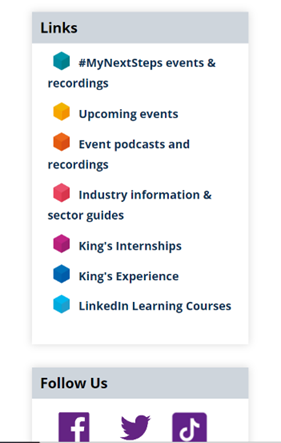
Often when we’re so focused on KCC, we forget about the King’s Careers & Employability KEATS page. I definitely did not use this as much as I should have. Here I will explain the difference between the two: while KCC is our booking platform, KEATS is our e-learning platform and they are both on different sites. Finding the KEATS page is fairly straightforward, if you keep scrolling past your modules on KEATS, you should be able to find it. When you click on the module on KEATS, you will come to a section that says Discover, Focus and Action. Understanding which phase you’re at which will help if you research will allow you to use the Careers service in a way that is helpful for you. In the tab on the left, there will be different resources depending on what kind of student you are , as well links to #MyNextSteps events which are about what to do after graduating, upcoming events/ event  recordings, industry information and sector guides, as well as LinkedIn Learning Courses which I did not know we had access to – but are no doubt highly valuable and something you can attach to your own LinkedIn account when completing a course in whatever you’re interested in.  

(Credit - Haleema Ayyub - A screenshot from the King's Careers and Employability KEATS page)
(Credit – Haleema Ayyub – A screenshot from the King’s Careers and Employability KEATS page)

I also recommend accessing King’s CareerConnect and the KEATS page via a PC/ laptop as it is easier to navigate the website from here as opposed to your phone as you’re able to see everything clearly. Furthermore, the industry information and sector guides have all the relevant information you need depending on what you’re interested in so make sure to check that out as there are multiple links to places where you can research job opportunities on alternative websites. 

Furthermore, regarding the practice interview system, this will be available on KEATS via Shortlist.Me which will provide mock online assessments and interviews. A practice interview is an hour/ 40 minute long appointment to help you prepare for an interview. You will also have the chance to practice interview answers and techniques with the help of a career consultant. The practice interview is a safe learning space that is there to support your unique situation- and the session can be changed to suit your needs so you can get the most out of your appointment.  

The CV checker is available via KCC providing content the student goes through in a linear order before having the option at the end to upload their CV and have it checked by an application advisor where they receive some feedback. This will be available from September onwards.  

If you ever have any questions regarding this whole process, always try to get in touch with the Careers service as they will do their best to help and guide you!  

Haleema Ayyub
Communications and Engagement Intern
Part of King’s Careers and Employability

The King’s Student Money Mentors blog shares our students’ personal experiences and thoughts on money-related topics. Any reference, opinions or recommendations on a particular company/brand are only the views of the student(s) who wrote the blog post. King’s College London, the Money & Housing Advice service and the Money Mentor project do not share the views in the blogs nor endorse any of the companies mentioned. Readers should conduct their own research before using any companies mentioned in our blog posts. 

Which bank accounts are best for students?  

Photo by Steve Johnson on Unsplash

It can be hard as a student to know where to put your money – there are so many options! But don’t worry, I have put together the key types of accounts and points to consider when you open a bank account to make the process easier. 

Student current accounts 

It is always a good idea to use a student’s current account for your immediate spending money as these offer generous overdrafts for hard times and often come with benefits specifically for students. These can include rail cards (my personal favourite), free cash when joining or cashback when you spend in shops. Pick the perks that suit you the most – a bigger 0% overdraft if you tend to overspend at the end of the month or a Tastecard for those who love to eat out! 

Savings accounts 

These are good accounts if you have a reliable amount to spare each month which you don’t necessarily need to access for a while. Often, they come linked to your current account so consider this when you pick a bank. You have to put a certain amount into the account each month in return for interest. Savings accounts which let you take money out at any time will have lower interest rates than those that hold your money for a fixed term so consider your saving goals. You won’t necessarily gain a lot of money from these accounts, but they are a reliable way to make a little extra income. 

ISAs 

ISAs are great accounts for saving money for the longer term. You gain interest with no taxation (although this generally wouldn’t affect students) and have a limit of putting £20,000 per year into any ISAs you own. They also come as a fixed term or easy access, again with lower rates on the easy access accounts. I like to use different fixed-term ISAs based on when I think I need to access the money. If I won’t need to use that money for 2 years, then I maximize my interest with a 2-year fixed ISA! Some ISAs have specific terms, for example, the Lifetime ISA is used to save up for your first house or pension. Other ISAs invest in stocks and shares, which may give better rewards but could also lose money depending on the investment performance. 

Premium bonds 

Another popular place to put ‘spare’ cash is in NS&I’s premium bonds. It works by buying ‘bonds’ for £1 each which are entered into a prize draw every month. Prizes range from £25 to £1 million but the average premium bonds user could expect an interest rate of 1.4% currently. Of course, the more bonds you have the higher the chances of you winning but there is a maximum of £50,000 worth of bonds per person at any time. It is not the most reliable method of making money but offers the chance to enter a lottery every month without spending anything. I’m still hoping to get that million! 

Other current accounts 

Whilst student accounts are a good choice, you can also open other current accounts at the same time. These can be good for other reasons – interest rates, fee-free overseas spending, cashback at certain places, and better online banking. It is also worth considering any switch offers, i.e., perks you get for switching to their bank account. I picked an account which allowed me to use my card abroad while I went on my summer exchange programme and got a £100 voucher for switching to the account! 

With any bank account, consider whether it meets your needs: easy access to cash to spend day to day, good interest rates for saving up for big goals in the future or no-fee spending abroad if you are an international student or love to travel. Check whether you need to put a certain amount of money in the account each month to receive the interest or other benefits. And lastly, review your bank accounts every so often so you can choose the best deals which align with your money goals – I like to do this every year at least. 

I like to use which.com and moneysavingexpert to find the latest information on bank accounts as they summarise all the information I need about each account type into one page. I hope this can help you get started with picking the best bank accounts for you! 

Rebecca Lam
King’s Student Money Mentor
Part of Money & Housing Advice

The King’s Student Money Mentors blog shares our students’ personal experiences and thoughts on money-related topics. Any reference, opinions or recommendations on a particular company/brand are only the views of the student(s) who wrote the blog post. King’s College London, the Money & Housing Advice service and the Money Mentor project do not share the views in the blogs nor endorse any of the companies mentioned. Readers should conduct their own research before using any companies mentioned in our blog posts. 
Savvy Spending!

Photo by Bruno Kelzer on Unsplash

Living in London can be very expensive, so it is quite important to know how to be a savvy spender. I’m going to share some of my tips and advice on spending consciously, including mindful spending, zero spend days and different methods I’ve noticed companies use to trap customers. Hopefully, after reading this blog post, you will feel a lot more confident when thinking about your finances and will come to realise that spending and budgeting isn’t as daunting as you might think! 

A savvy spender is someone who spends their money wisely. Rather than just sticking to their budget by avoiding spending on anything else, a savvy spender will make sure that what they do spend money on is worth it and is the best deal. It’s always a good idea to implement some savvy spending habits into your lifestyle because it allows you to truly make the most of your money. A savvy spender won’t get caught out by sneaky marketing tricks designed to make us spend more. Instead, they’ll be switched on to make sure there’s no wasted spend, meaning the money they have can go further.  

To be a savvy spender, you need to make sure everything you purchase is a conscious decision. When you’re acting consciously, you’re able to stop and ask yourself a few questions before you buy, which will make sure you’re a) not buying something you don’t really want or need or b) spending too much money when you could get the same thing for less. In today’s day and age, we are inundated with deals, offers and cleverly curated shops/online stores that are all designed to make us shop emotionally rather than consciously. The key to being a savvy spender is to understand that and be wise to their tricks. 

Mindful spending is not allowing emotions to lead your spending decisions. Taking the time to consider whether you want or need something can add up to hundreds of pounds in savings. Telling yourself ‘No’ when it comes to purchases isn’t boring or tedious, it’s powerful. It isn’t about cutting out all of your spend either. By being mindful about your spending, you can decide what’s important to you. If you enjoy your morning coffee from your local coffee shop, we’re not saying don’t buy it. But by asking yourself ‘Do I need this? Maybe if I woke up 5 minutes earlier, I could make and bring my own’. You’ll start to find that you’ll cut out some unnecessary spending. 

Zero spend days are a challenge to not spend anything for one day. Imagine this, you’ve done your food shop for the week, but you’re tempted for a takeaway after a long day. If you commit to not spending on that day, you might just fight off the urge to splurge on a takeaway. It sounds simple but it’s an effective way to take a step back and appreciate the things that you’ve already paid for and save money. Once you get into the habit of maybe one no-spend-day a week, you’ll realise how easy and rewarding it is. Then you can take it as far as you like. People do no spend weeks, months and sometimes even a whole year where they just spend on essentials. Maybe that could be you but set milestones that work for you. 

There are a variety of different ways brands use scarcity marketing to rush you into a purchase. Some examples include: 

  • Counting down how many hours and minutes you have left to get next day delivery  
  • Alerting you when stocks are low or showing how many of an item are left in stock  
  • Holiday sites telling you how many people ‘favourite’ a hotel 
  • Flash sales and time-limited offers 
  • Limited edition collectibles  

There are lots of ways that supermarkets try to maximise your spend in-store. Look out for these examples on your next trip:  

  • Essential items: Think bread, milk, eggs – these are often stocked further away from the entrance and apart from each other so you need to walk through more of the store to get there and hopefully pick up items you didn’t come in for along the way.  
  • Expensive items: The most profitable or most expensive items often sit in the middle of the shelf directly in your line of sight and popular combinations will be stocked together to encourage you to buy both.  
  • Impulse buys: One you may already know – tills are littered with small purchases to encourage ‘essential’ last minute purchases.  
  • End aisles: We might be used to seeing cheaper deals at the end of aisles but its important to make sure you’re actually bagging yourself a bargain and haven’t just been conditioned to think you will. People are 30% more likely to buy items at the end of an aisle than in the middle! 
  • Sensory overload: Shops use sight, smell, sound and taste against you in a bid to get you to part with your cash. Smells like freshly baked bread can trigger hunger, causing you to pick up more than you came in for and free samples can encourage a purchase you hadn’t intended. slow music can be used to slow you down and encourage more time in store.  

When you’re shopping in store, I would recommend making a shopping list and having a clear budget in mind – and avoid shopping when hungry! 

The same goes for online sites, which have their own ways to encourage spending. Sites will offer free shipping if you spend a certain amount, encouraging you to keep shopping and buy more. Amazon Prime and ASOS Premier delivery can be a great way to save on shipping costs, but these products are designed to keep you shopping more often and can sometimes work out to be more expensive than other places. So always shop around and be careful they don’t end up costing more in the long run. It’s common practice now for sites to offer savings on your first order if you subscribe to their email list. There’s no harm in saving yourself some cash using these in the short term but beware – your inbox will soon fill up with deals and sales which can be hard to say no to. These emails are a double-edged sword. They could save you money if you see a sale or discount code for an item you were already going to buy but they can encourage more spending too. It could be worth unsubscribing when you’ve made your saving to avoid falling into the trap. 

I hope by lifting the curtain on some of these tips and tricks, you’ll feel empowered enough to make informed decisions about your spending – good luck! 

Amani Parvaiz
King’s Student Money Mentor
Part of Money & Housing Advice

The King’s Student Money Mentors blog shares our students’ personal experiences and thoughts on money-related topics. Any reference, opinions or recommendations on a particular company/brand are only the views of the student(s) who wrote the blog post. King’s College London, the Money & Housing Advice service and the Money Mentor project do not share the views in the blogs nor endorse any of the companies mentioned. Readers should conduct their own research before using any companies mentioned in our blog posts.